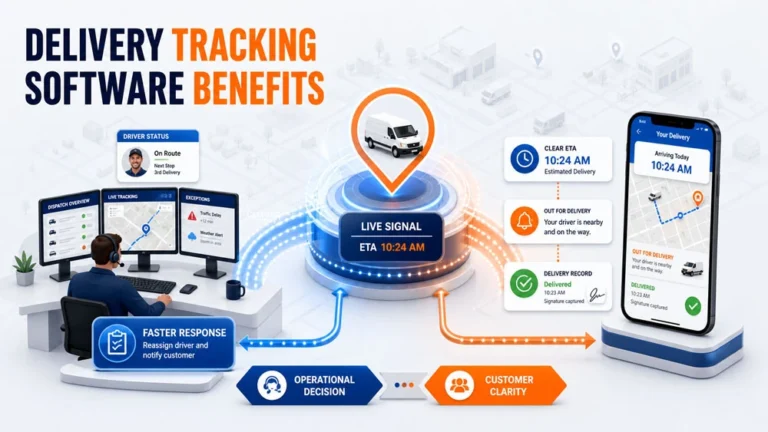
A tracking screen does not create value simply because a vehicle appears on a map.
The value begins when a location update helps a dispatcher recognize a delay, gives customer service a reliable answer, helps a recipient prepare for arrival, or creates a clearer record after delivery.
This distinction matters when evaluating delivery tracking software benefits. Visibility is not the final outcome. It is the information layer that helps people make earlier, more consistent decisions during delivery execution.
When tracking information remains connected to assignments, order status, ETA, customer communication, and completion records, its effect can extend beyond the dispatch screen. It can reduce information recovery, clarify customer commitments, improve exception response, and help the operation learn from what actually happened.
Where Delivery Tracking Software Benefits Actually Come From
Tracking software creates value through a simple chain:
Signal → shared context → decision → operational outcome
A location update is a signal. It becomes useful when the operation understands which driver, route, stop, customer commitment, and order status it belongs to.
The complete mechanics are explained in our last mile delivery tracking guide. This article focuses on what changes after that visibility becomes usable.
| Visibility signal | Decision it supports | Operational outcome | Customer outcome |
|---|---|---|---|
| Route has not started | Does dispatch need to intervene? | Earlier investigation | More reliable expectations |
| ETA has moved outside the accepted window | Can the commitment still be protected? | Faster exception response | Earlier notice of a delay |
| Driver has arrived | Is the customer or site ready? | Better stop coordination | Time to prepare for handoff |
| Delivery has failed | What action is required next? | Clearer recovery ownership | Faster rescheduling or follow up |
| Delivery is complete | Is the required evidence available? | Easier record retrieval | Clear confirmation of completion |
The software does not create every outcome automatically. It gives the responsible person enough context to act before an information gap becomes a larger operational problem.
Operations Spend Less Time Reconstructing the Present
Without connected tracking, dispatchers often have to recreate the current delivery state.
They may check the original route, call the driver, read customer notes, compare messages, and ask another department whether the order changed. By the time the information is assembled, the opportunity to protect the original commitment may already be gone.
Connected visibility gives the operation a shared answer to questions such as:
- Who currently owns the order?
- Has the route started?
- What status did the driver record?
- Is the vehicle progressing through the expected area?
- Has the estimated arrival changed?
- Was the stop completed or failed?
- What information still requires attention?
This does not eliminate dispatcher judgment. It removes some of the search work that happens before judgment can be applied.
Exceptions Can Be Recognized Earlier
A late delivery is easier to manage while it is still a developing risk.
Suppose a driver is behind schedule after one stop takes much longer than expected. If dispatch can see the changed route progress and ETA, the team can assess which later commitments may be affected.
Depending on the situation, the response might involve:
- Contacting the driver
- Reviewing the remaining workload
- Reassigning an order
- Updating customer service
- Notifying the recipient
- Recording a reason for the delay
Our article about last mile delivery execution explains how active assignments, driver communication, and exceptions interact during the delivery day.
One of the most important delivery tracking software benefits is therefore not the promise that delays disappear. It is that the operation may discover the problem early enough to make a useful decision.
Actual Execution Becomes a Planning Input
Route plans are built from assumptions about travel time, service duration, order readiness, access, and driver capacity.
Tracking shows how those assumptions performed in practice.
If the same location repeatedly creates long service times, the planning data may need to change. If drivers frequently deviate from a sequence, the operation may need to investigate access restrictions, parking conditions, or unrealistic stop timing.
A connected delivery route management workflow can use this execution context to support better planning discussions.
Tracking does not optimize tomorrow’s routes by itself. It provides evidence about where today’s plan differed from reality.
Customers Receive a Usable Commitment
Customers usually do not need access to every internal delivery detail.
They need a clear answer to a smaller set of questions:
- Has the delivery been confirmed?
- Is it still expected today?
- When is it likely to arrive?
- Has something changed?
- Is any action required?
- Was the delivery completed?
Customer facing tracking should translate operational information into a clear delivery experience.
ETA Updates Make the Delivery Window More Useful
A scheduled window might tell the customer that delivery is expected between 1 p.m. and 4 p.m. An updated ETA can make that commitment easier to manage as the driver approaches.
The ETA should still be treated as an estimate. Traffic, service duration, access delays, and changes to the active route can affect it.
The official Google Maps fleet tracking documentation shows how vehicle location can be connected with progress, remaining distance, task status, and ETA. This illustrates why an ETA becomes more useful when it reflects current execution rather than only the original schedule.
Notifications Can Reduce Availability Related Failures
For attended deliveries, the customer may need time to reach the property, clear an access area, arrange building entry, or prepare for an installation.
A confirmation, reminder, ETA update, or arrival notice can help the customer prepare.
These updates cannot prevent every failed attempt. They will not correct a wrong address, solve a vehicle problem, or make an unavailable customer respond. They can, however, reduce failures caused by unclear timing or missed communication.
This connects directly with the broader delivery scheduling benefits of establishing a realistic commitment before the route is released.
Delays Become Easier to Explain
Silence creates uncertainty.
When a delivery is late and the customer has no current information, customer service becomes the tracking system. Employees must contact dispatch or the driver before answering even a basic status question.
A useful tracking experience gives the customer an appropriate update while preserving more detailed operational information for internal teams.
The goal is not to expose every route movement. It is to communicate what the customer needs to know at the right point in the delivery.
Customer Service Works From the Same Delivery Record
Customer service benefits when the current status, ETA, customer communication, and completion record remain connected.
Instead of asking several teams what happened, an employee may be able to review:
- The latest delivery status
- The assigned driver or route
- The current ETA
- Notifications already sent
- Recorded delivery notes
- Completion evidence
- Previous attempts or changes
This can make status inquiries easier to resolve and reduce contradictory answers between dispatch and customer service.
Tracking should not be evaluated only by whether customer contacts decrease. Some customers will still call. The more useful question is whether the team can answer accurately without reconstructing the delivery from separate sources.
Completion Becomes Easier to Verify
Tracking value continues after the driver reaches the destination.
A complete delivery record may connect the final status with a timestamp, notes, photo, signature, or other required evidence.
This helps the office answer questions such as:
- Was the order delivered?
- When was completion recorded?
- Was a recipient signature required?
- Is there a photo?
- Did the driver report an exception?
- Does another attempt need to be scheduled?
Proof of delivery has its own workflows, evidence types, and requirements, which belong to a separate article. Within this article, its role is the final step in the visibility chain.
The customer sees that the delivery ended. The operation retains enough context to investigate the outcome later.
Who Benefits From Each Type of Visibility?
| Stakeholder | Information needed | Decision or action | Useful measure |
|---|---|---|---|
| Dispatcher | Driver, route, status, ETA, exceptions | Intervene or allow execution to continue | Exception detection time |
| Driver | Current route, stop details, instructions | Complete and update the delivery | Missing status rate |
| Customer service | Status, communication history, outcome | Answer or escalate an inquiry | Time to resolve status inquiries |
| Customer | Commitment, ETA, relevant delay, completion | Prepare, respond, or confirm receipt | Tracking link usage |
| Operations manager | Patterns across routes and outcomes | Improve rules and planning inputs | Repeated exception rate |
| Administration | Completion record and evidence | Close or investigate the order | Record retrieval time |
The strongest delivery visibility benefits appear when each stakeholder receives the information required for their role.
Giving everyone the same dashboard may create more noise without improving a single decision.
Tracking Can Move Work Instead of Removing It
Tracking software does not always reduce workload.
Poorly designed tracking can transfer work from one team to another or create new questions.
Common examples include:
- A stale ETA that looks current
- A map location without a meaningful order status
- Too many customer notifications
- Internal statuses exposed without explanation
- A completed delivery with missing evidence
- An assignment change that does not update every view
- A delay notification with no next step
In these situations, the software creates visibility without control.
Before implementation, the operation should define:
- Which event changes each status
- Who owns inaccurate information
- When an ETA change requires review
- Which updates customers should receive
- What evidence is required at completion
- How exceptions move between dispatch and customer service
The benefit comes from the workflow built around tracking data, not from the presence of a map alone.
How to Measure Delivery Tracking Software Benefits
Begin with a baseline from the current process.
Useful measures include:
- Manual driver contacts for routine status checks
- Time between an exception occurring and dispatch noticing it
- Customer status inquiries per completed delivery
- Time required to answer a delivery inquiry
- Percentage of active deliveries with a current status
- Percentage of eligible customers receiving ETA updates
- Failed attempts related to customer availability
- Completion records missing required evidence
- Time required to retrieve a historical delivery record
Do not assume that every change came from tracking software.
Route design, driver training, order quality, customer scheduling, warehouse readiness, and service policies can affect the same measures.
A useful evaluation compares the workflow before and after implementation and identifies which part of the process actually changed.
How It’s Here Connects Visibility to Delivery Work
It’s Here connects tracking information with the wider delivery record.
Its verified delivery management software capabilities include:
- Real time shipment and driver visibility
- Current shipment location and status
- ETA information
- Map based live tracking
- A Driver App
- Branded customer alerts
- Delivery confirmations
- Night before delivery reminders
- Real time ETA updates
- Branded tracking links
- Order history
- Photo and signature proof of delivery
The operational value comes from how these capabilities remain connected.
Dispatch can review active progress. Customers can receive relevant delivery updates. Drivers can record the final outcome. Customer service and the office can return to the order history when a question appears later.
These capabilities do not guarantee that every delivery will be on time or every customer will be available. They give the operation a clearer shared record for managing the work and responding when conditions change.
Make Visibility Earn Its Place in the Workflow
The most valuable delivery tracking software benefits appear when information leads to a better decision.
Operations teams spend less time reconstructing the current state. Dispatch can recognize exceptions earlier. Customer service can answer with more confidence. Customers receive clearer expectations, and completion information remains available after the delivery ends.
Tracking should not be judged by how much data appears on a screen.
It should be judged by whether the right person can understand what is happening, decide what to do next, and preserve an accurate record of the result.
FAQ
How Does Real Time Tracking Benefit Logistics Operations?
Real time tracking helps logistics teams see current driver location, route progress, order status, ETA changes, and delivery outcomes. This can reduce information recovery and support earlier exception decisions.
Can Delivery Tracking Software Reduce Failed Delivery Attempts?
It can reduce attempts caused by unclear timing or customer unavailability when reminders and ETA updates reach the customer in time. It cannot prevent failures caused by every address, access, vehicle, inventory, or communication problem.
What Delivery Information Should Customers Be Able to See?
Customers typically need confirmation, current delivery status, an appropriate arrival estimate, relevant delay information, and completion confirmation. Internal route names, driver notes, and unresolved operational statuses should usually remain private.
How Should a Company Measure the Value of Delivery Tracking?
Compare the workflow before and after implementation. Measure status contacts, exception detection time, customer inquiries, ETA update coverage, availability related failures, missing completion evidence, and record retrieval time.