A pallet does not become Client A’s inventory because someone writes the client’s name on a receiving sheet. Ownership must remain attached to every transaction that follows.
That is the challenge of a third party logistics warehouse. Clients may share resources, but their inventory and instructions cannot blur together. The warehouse needs shared execution with clear client boundaries.
This is the problem a 3PL warehouse management system is designed to control. It gives the operator one environment for running warehouse work while preserving which client owns the stock, which rules apply, who can see the data, and which services were completed.
What Is a 3PL Warehouse Management System?
A 3PL warehouse management system is software used by third party logistics providers to receive, store, control, fulfill, and ship inventory for multiple clients within a shared warehouse operation.
Like a standard WMS, it supports warehouse processes such as receiving, putaway, location control, picking, packing, shipping, adjustments, and inventory history. The difference is that every important transaction also needs client context.
A platform may manage warehouse tasks well and still be a poor fit for 3PL operations if it cannot identify who owns the inventory, which rules apply, who may access the record, and what work was completed. A 3PL WMS should therefore be evaluated as both an execution system and a client control system.
Why a Standard Warehouse Model Is Not Enough
A warehouse serving one business usually works from one inventory ownership model, one set of operating rules, and one management structure. A 3PL may serve a retailer, an ecommerce brand, a manufacturer, and a distributor from the same facility.
Those clients can require different product identifiers, receiving controls, storage restrictions, order priorities, packing instructions, documents, permissions, and value added services.
The warehouse team still needs a practical master view of labor and work. Running a separate disconnected system for every client makes facility level coordination difficult. Combining every client into one undifferentiated record creates a more serious problem: inventory, instructions, and reporting can become unreliable.
The operating model therefore needs two views at the same time:
- A shared operational view for managing warehouse capacity, tasks, locations, and workload.
- A protected client view for inventory ownership, orders, rules, history, and reporting.
The appropriate warehouse fulfillment software should support both without making employees reconstruct client context outside the system.
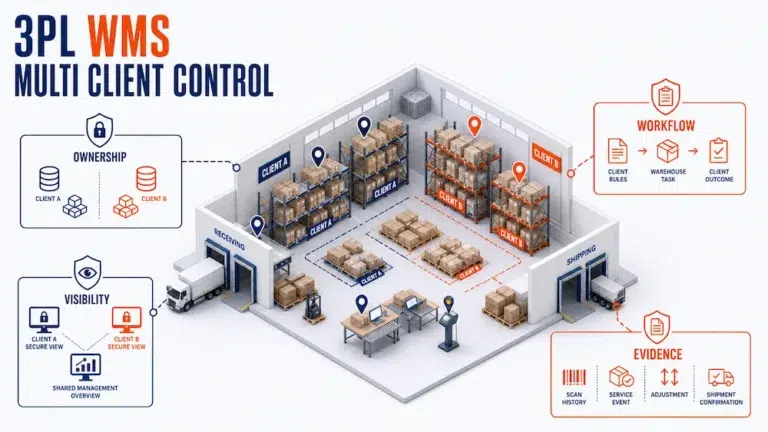
The Four Client Boundaries a 3PL Warehouse Management System Must Protect
The most useful way to evaluate multi client warehouse management is to test four boundaries.
| Client boundary | What must remain separate | What can be shared | Failure signal |
|---|---|---|---|
| Ownership | Inventory quantities, lots, serials, adjustments, and order allocation | Building, equipment, and some storage zones | Stock appears available to the wrong client |
| Workflow | Client instructions, service levels, packing rules, and exception decisions | Standard task types and trained labor | Staff complete the right task using the wrong rule |
| Visibility | Client orders, inventory, documents, reports, and account access | Internal management oversight | One client can see or change another client’s data |
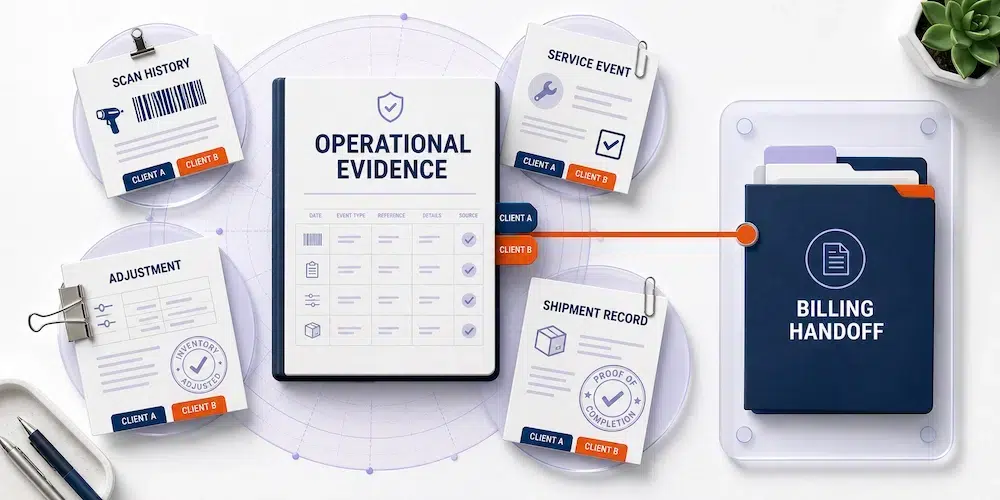
| Evidence | Scan history, service events, shipment records, and adjustments | Common audit structure | The 3PL cannot prove what happened for a specific client |
These boundaries are related but not interchangeable. Physically separating stock does not protect digital access, and a separate login does not prove that warehouse transactions used the correct owner.
Microsoft’s warehouse documentation offers one concrete example of this design principle: systems can use an inventory owner dimension and location rules to prevent stock owned by different parties from being mixed in the same location. The exact configuration varies by platform, but the broader requirement is stable: ownership must be part of the transaction, not an informal note. See the technical example in Microsoft Learn’s guidance on inventory owner segregation.
How Work Moves Through a Multi Client Warehouse
The physical stages may resemble any other warehouse. What changes is the client context carried through them.
Client Setup Comes Before the First Receipt
Onboarding should define more than a client name. The operation needs the data and rules required to recognize that client’s work.
This may include:
- Client and merchant identifiers
- Authorized users and roles
- Product master data
- Units of measure and barcode rules
- Receiving and discrepancy requirements
- Location and storage restrictions
- Order and shipping instructions
- Required documents and reports
- Approved service types
If these elements are unclear, the first inbound order becomes a live configuration exercise and employees begin creating local workarounds.
Receiving Establishes Ownership
At receiving, the team must verify what arrived and connect it to the correct client, product, quantity, and document.
A reliable receipt should preserve:
- The client owner
- Source order or reference
- Product and quantity
- Lot, serial, or expiry data when required
- Condition and discrepancy status
- Time and user confirmation
- The next permitted action
Inventory should not become available merely because goods crossed the dock. It becomes trustworthy when the receipt has been validated according to the client’s rules.
Putaway Preserves the Boundary
The location decision must respect ownership and storage requirements. Depending on the facility, clients may use dedicated areas, shared zones with logical separation, or a combination of both.
The essential control is the ability to prevent stock from entering a location that breaks ownership, product, hazard, temperature, or handling requirements.
When teams need a deeper stock level view across products and locations, an inventory management system may own broader inventory planning and availability intent. The 3PL WMS remains responsible for the warehouse transactions that change those records.
Fulfillment Applies Client Specific Rules
An order should allocate only eligible stock belonging to the correct client. The resulting pick, pack, and ship work must carry the instructions required for that account.
Two clients may sell the same product but require different packaging, documents, inserts, labels, or carrier services. A worker should not have to remember those differences or search through email before completing the order.
The workflow should present the relevant rule at the point of work and require confirmation when an action needs evidence.
Exceptions Stay Attached to the Account
Damaged goods, shortages, substitutions, inventory holds, failed scans, and shipping changes need explicit ownership.
A useful exception record identifies:
- The affected client and inventory
- What prevented normal work
- Who reviewed the issue
- Which decision was made
- Whether inventory status changed
- Whether the client needs to be informed
- Which follow up action remains open
Without this structure, an exception can become a general warehouse note that is difficult to find during a client review.
Billing Starts With Operational Evidence
A 3PL WMS does not need to own the complete invoice process. It does need to create reliable service events that a billing workflow can use.
Examples include:
- A receipt was completed
- A pallet or package entered storage
- Items were picked or packed
- Labels or kits were produced
- An order was shipped
- A defined value added service was performed
The handoff should include the client, service, quantity or unit, location, date, source transaction, and status required by the billing rules. This keeps operations focused on recording what happened while the financial system determines how the contract treats that event.
Detailed pricing rules, billing cycles, invoice review, versioning, and charge audits belong to the site’s dedicated 3PL billing and invoicing software page. Recreating that topic inside this article would blur both the operational workflow and search intent.
Data Requirements That Deserve a Demo Test
A feature list cannot prove that a system protects client boundaries. A realistic demonstration should test the relationships between records.
Prepare a small scenario with:
- Two clients that carry the same SKU
- One receipt with a quantity discrepancy
- Separate storage or handling rules
- An order for each client
- A user who should see only one account
- A value added service recorded for one order
- An adjustment requiring an audit record
- A shipment confirmation needed by another system
Then ask the vendor to show the complete chain. Confirm that the same product can remain distinct by owner, allocation uses the correct inventory, client rules reach the worker, access stays restricted, adjustments remain traceable, and completed services reach billing. This boundary test is more revealing than a perfect sample order created entirely by the vendor.
A Verified It’s Here 3PL Workflow Example
The official It’s Here Fulfillment WMS page documents multi merchant management with a centralized master view and separate merchant access. It states that merchant data, orders, reports, and performance information remain organized by account, while administrators control access.
The same product page documents support for multiple warehouses, warehouse locations such as aisles, racks, bins, and pallets, product records, receiving and shipping orders, real time inventory information, and scanner workflows for receiving, picking, packing, transfers, and inventory audits.
For a 3PL, the important relationship is how these capabilities connect. A merchant record provides the client context. Warehouse and location records establish where stock is controlled. Receiving and scanner activity update operational records. Separate merchant access protects visibility. Completed warehouse services can then supply evidence to the billing process.
These are verified capabilities, not a claim that every 3PL should use the same configuration. A demo should still test the buyer’s client structures, permissions, item data, exceptions, documents, and service handoffs.
When the Current System Stops Protecting Client Boundaries
The need for a purpose built 3PL workflow appears through repeated control problems rather than a specific client count. Warning signs include ownership spreadsheets, instructions stored in email, overlapping SKU records, manual client reports, adjustments without an audit history, services reconstructed before billing, and undocumented workarounds copied during onboarding. Several appearing together suggest that the current tools no longer preserve the boundaries on which the 3PL relationship depends.
Build the Operation Around the Client Boundary
Understanding what is 3PL warehouse management system starts with a simple distinction: resources may be shared, but ownership and accountability cannot be.
A 3PL warehouse management system allows warehouse teams to coordinate labor, locations, and tasks across the facility while keeping each client’s inventory, instructions, access, and evidence intact. It also creates a controlled handoff between warehouse execution and billing without turning the warehouse article into a financial software guide.
Before selecting a platform, follow the same item through onboarding, receiving, storage, fulfillment, exception handling, shipping, reporting, and service capture. If the client identity becomes unclear at any stage, the workflow is not ready.
FAQ
What Is the Difference Between a 3PL WMS and a Standard WMS?
A standard WMS controls warehouse inventory and tasks for an operation. A 3PL WMS must also preserve separate ownership, workflows, access, reporting, and service evidence for multiple clients using shared warehouse resources.
Does a 3PL Warehouse Management System Include Billing?
Some platforms connect warehouse events with billing capabilities, but the responsibilities should remain clear. The WMS records completed operational services, while the billing workflow applies contract rules, reviews charges, and manages invoices.
Can Multiple Clients Store the Same SKU in One Warehouse?
Yes, if the system can distinguish inventory ownership and prevent one client’s order from allocating another client’s stock. Physical or logical location rules may also be needed according to the operating model.
What Data Should Be Ready Before Onboarding a 3PL Client?
Prepare client identifiers, authorized users, product data, units of measure, barcode rules, receiving requirements, storage restrictions, fulfillment instructions, required documents, and approved service types.
How Should a 3PL Test a WMS Before Selection?
Use a scenario with at least two clients, overlapping products, different rules, restricted user access, an exception, a service event, and a shipment handoff. Confirm that client ownership remains clear through every transaction.