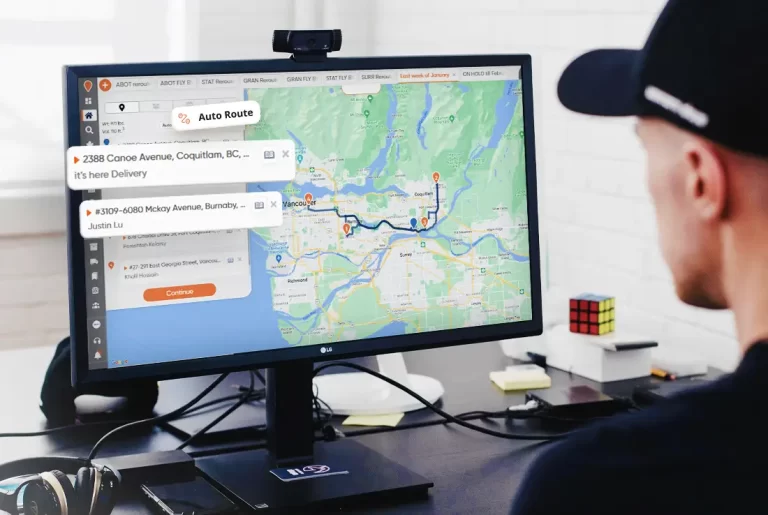
Last-mile delivery, This is where profit is won or lost!
Fuel costs rise. Drivers churn. Customers expect real-time updates. And one delayed stop can trigger a cascade of service failures.
If one were to walk onto a dispatch floor of a traditional 3PL or regional distributor, one would likely find the following: a chaotic desk overwhelmed with neon-colored “post-it notes,” dispatch personnel yelling over ringing phones trying to find “missing” trucks, and whiteboards plastered with magnets signifying thousands of dollars in idle assets. In such an environment, the last mile is not a process; it is a chaotic choke point where profits are slowly drained stop by stop.
For modern fleet leaders, the “modernization imperative” is no longer a choice—it is a survival mechanism.
So the question isn’t whether to modernize delivery operations.
It’s this: What is delivery management software and how does it actually transform performance?
In this pillar guide, we’re going to explore:
- What delivery management software really is
- What sets it apart from delivery fleet management software
- What are the core features that drive ROI
- How to evaluate the best solutions for your business needs
- What Operations Managers and 3PL leaders should be focused on
So let’s get started!
What Is Delivery Management Software?
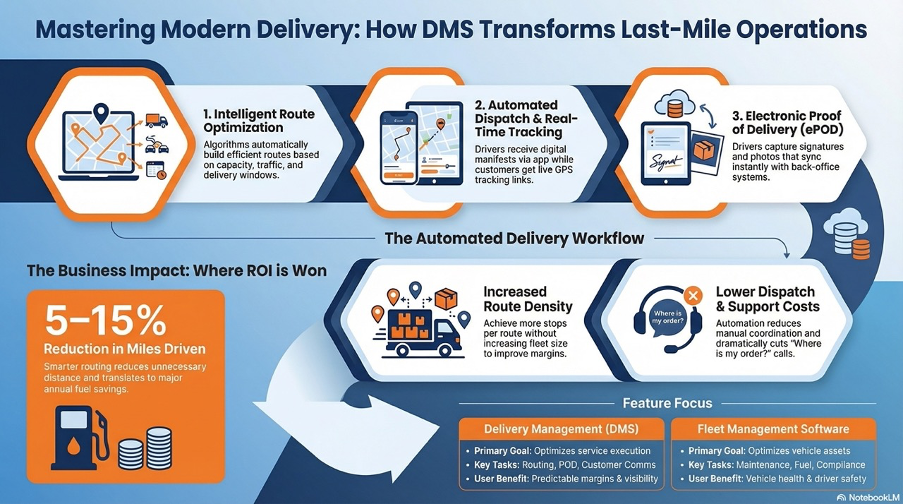
a Delivery Management Software (DMS) – like It’s Here is a single, centralized system that plans, manages, tracks, and optimizes last-mile deliveries in real-time.
It brings the entire ecosystem of dispatchers, drivers, customers, and back-office applications together on a single, integrated process.
- Fundamentally, it manages:
- Route optimization and planning
- Order dispatching
- Real-time GPS tracking
- Electronic Proof of Delivery (ePOD)
- Driver communication
- Delivery analytics and reporting
Think of it as the operating system for your last-mile operation.
Without it, teams rely on spreadsheets, manual dispatching, phone calls, and guesswork. With it, operations become automated, data-driven, and scalable.
For companies exploring a modern Delivery Management Software platform, the goal isn’t just visibility. It’s measurable efficiency gains and predictable margins.
Why Delivery Management Software Matters More Than Ever
Customer expectations are shaped by Amazon-level visibility. Even B2B clients expect:
- Live tracking links
- Narrow delivery windows
- Automated notifications
- Instant proof of delivery
Meanwhile, internally:
- Labor costs are rising
- Fuel volatility impacts margins
- Driver shortages increase complexity
- SLA penalties hurt profitability
Manual processes can’t keep up.
And when route density increases, inefficiencies compound fast.
How Delivery Management Software Works (Step-by-Step)
Let’s simplify the workflow.
1. Order Intake
Orders enter the system via:
- ERP integration
- E-commerce platform
- API connection
- Manual upload
The platform consolidates all delivery data into a centralized dashboard.
2. Route Optimization
The system automatically builds the most efficient routes based on:
- Delivery windows
- Vehicle capacity
- Driver availability
- Traffic conditions
- Geographic clustering
3. Automated Dispatch
Drivers receive routes through a mobile app. No printing manifests. No manual calls.
Dispatchers monitor progress in real time.
4. Real-Time Tracking
Every stop is tracked via GPS. If delays occur, customers are notified automatically.
This reduces inbound support calls dramatically.
5. Electronic Proof of Delivery
Drivers capture:
- Signature
- Photo
- Timestamp
- Geo-verification
That data syncs instantly with back-office systems.
6. Analytics & Optimization
Managers gain visibility into:
- On-time delivery rates
- Cost per stop
- Fuel efficiency
- Driver productivity
- Current patterns in delivery failures
And this is where the real ROI lives.
What Is Delivery Fleet Management Software?
Now let’s clarify a common confusion.
Many ask: What is delivery fleet management software?
While related, it focuses primarily on vehicle and driver oversight rather than end-to-end delivery workflows.
Fleet management software typically includes:
- Vehicle tracking
- Maintenance scheduling
- Fuel usage monitoring
- Driver behavior analytics
- Compliance management
Delivery management software, on the other hand, focuses on:
- Route planning
- Order orchestration
- Customer communication
- Proof of delivery
- Dispatch workflows
There is overlap. But the strategic objective differs.
Fleet software optimizes assets.
Delivery management software optimizes service execution.
The most advanced platforms combine both capabilities into one ecosystem.
The Business Impact: Where ROI Actually Comes From
Operations leaders don’t invest in software for features.
They invest for results.
Here’s where measurable returns typically emerge:
1. Reduced Miles Driven
Smarter routing reduces unnecessary distance.
Even a 5–15% reduction in miles translates to major fuel savings annually.
2. Higher Route Density
More stops per route without increasing fleet size.
That’s pure margin improvement.
3. Fewer Failed Deliveries
Automated notifications and optimized time windows reduce missed stops.
4. Lower Dispatch Labor
Automation reduces manual route building and phone coordination.
5. Improved Customer Retention
Real-time tracking improves service perception.
Understanding Route Optimization: Why It’s More Complex Than It Sounds
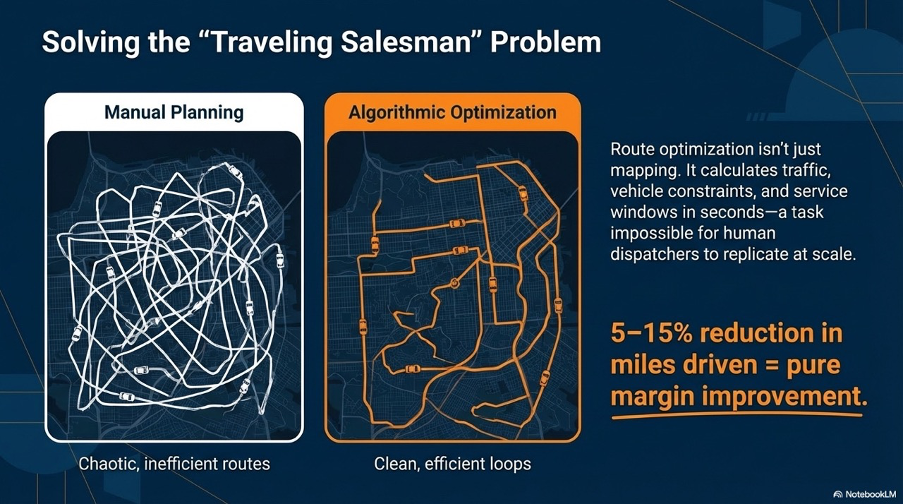
At its core, route optimization is a version of the “Traveling Salesman Problem,” one of the most studied optimization problems in logistics and mathematics.
It sounds simple. It isn’t.
Modern delivery management platforms use advanced algorithms to solve this at scale—accounting for traffic, constraints, vehicle types, and service windows in seconds.
Humans can’t replicate that manually.
What Is the Best Delivery Management Software?
This is the question every Operations Manager eventually asks. The answer depends on your operational complexity. First, look at this list:
Top 10 Delivery Management Software 2026 Comparison
| Software | Best For | Key Strengths | Typical Ideal User |
| ItsHere Delivery Management | Balanced all-in-one delivery execution | Comprehensive dispatch, route optimization, real-time tracking; strong automation + analytics | Ops Managers, 3PLs seeking platform ROI & visibility |
| Onfleet | Scalable last-mile operations | Intuitive driver app, solid real-time tracking, broad integrations | Mid-size fleets & delivery teams |
| Bringg | Enterprise delivery orchestration | Flexible omnichannel delivery, deep integrations | Large retailers & enterprise logistics |
| FarEye | Predictive and automated workflows | AI-driven routing & ETA prediction | Complex multi-node networks |
| DispatchTrack | AI optimized delivery execution | Intelligent ETAs + dispatch automation | High-volume operations |
| Locus | Intelligent logistics planning | Hyper-local routing + automation insights | Growing fleets with analytics focus |
| Route4Me | Multi-stop routing | Advanced route planning and territory logic | Teams needing complex routing efficiency |
| Detrack | POD + visibility backbone | Real-time GPS, ePOD, automated notifications | Courier services & delivery orgs |
| Track-POD | Automated delivery workflows | Digital proof, route planning, customer portal | Operations needing end-to-end digitization |
| Routific | Simple & cost-effective routing | Fast route generation + driver app | Small–mid delivery teams |
But here’s how to evaluate them:
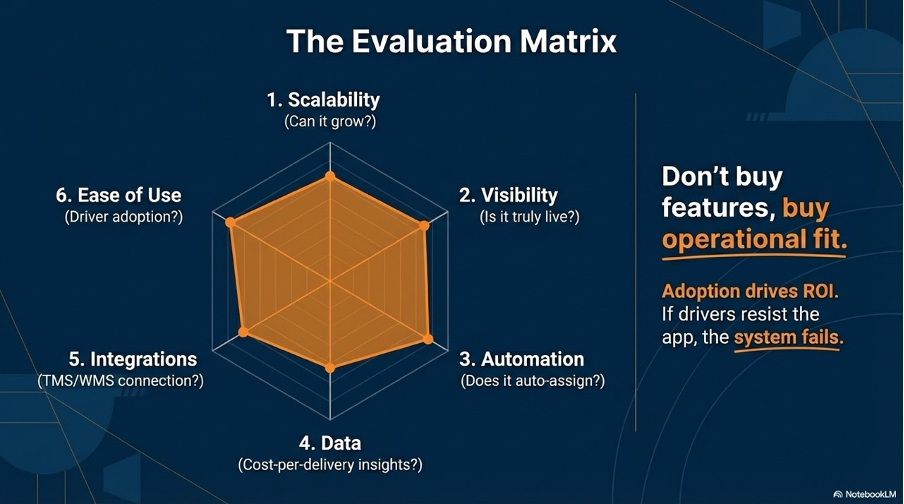
1. Scalability
Can it handle growth from 20 routes to 500 without performance loss?
2. Real-Time Visibility
Is tracking truly live? Or delayed?
3. Automation Depth
Does it:
- Auto-assign routes?
- Send automated customer notifications?
- Sync with ERP systems?
4. Data & Reporting
Can you track KPIs like:
- Cost per delivery
- On-time percentage
- Driver efficiency
5. Integration Capabilities
Does it connect with:
- TMS
- WMS
- CRM
- Accounting systems
6. Ease of Use
Adoption drives ROI. If drivers resist it, the system fails.
For 3PL providers especially, flexibility is critical. Multi-client operations require configurable workflows and branded tracking experiences.
When evaluating platforms like Delivery Management Software, focus less on feature checklists and more on operational fit and measurable efficiency improvements.
Who Needs Delivery Management Software the Most?
While almost any delivery-based operation benefits, it’s especially valuable for:
- 3PL companies managing multiple clients
- Regional distributors
- Retailers with private fleets
- Food & beverage distributors
- Medical supply distributors
- E-commerce fulfillment operations
If your team manages more than 20–30 daily routes, manual systems become a liability.
Signs Your Operation Has Outgrown Manual Processes
If you recognize these, it may be time:
- Dispatchers working overtime daily
- Frequent customers “Where’s my order?” calls
- Route changes handled via phone
- No visibility into driver performance
- Inconsistent proof of delivery documentation
- Rising cost per stop
Delivery operations are data problems. Not manpower problems.
The right Delivery Management Software transforms chaos into structured, automated workflows.
The Strategic Shift: From Reactive to Predictive Logistics
Traditional delivery operations react.
Modern ones predict.
With the right platform, you can:
- Forecast delivery capacity
- Identify underperforming routes
- Adjust territories proactively
- Simulate route changes before implementation
That’s where competitive advantage lives.
Not just tracking trucks. But optimizing the entire system.
Final Thoughts: Efficiency Is Now a Competitive Weapon
Delivery is no longer just a cost center.
It’s a customer experience driver. A brand differentiator. A margin lever.
And for Operations Managers and 3PL leaders in North America, the pressure isn’t slowing down.
The question isn’t whether to modernize.
It’s how fast you can do it.
If you’re evaluating solutions, explore how a purpose-built Delivery Management Software platform can align automation, visibility, and analytics into one scalable system.
Because efficiency compounds. And so do inefficiencies.
FAQs
1. What is delivery management software used for?
Delivery management software is used to plan routes, dispatch drivers, track deliveries in real time, capture proof of delivery, and analyze operational performance to improve efficiency and reduce costs.
2. What is the difference between delivery management software and fleet management software?
Delivery management software focuses on route planning, dispatching, and customer communication. Fleet management software focuses on vehicle health, maintenance, fuel tracking, and driver behavior monitoring.
3. What is the best delivery management software?
The best delivery management software depends on operational size, integration needs, automation depth, and scalability. Companies should evaluate platforms based on ROI potential, real-time visibility, and system compatibility.
4. How does delivery management software improve ROI?
It reduces miles driven, increases route density, lowers dispatch labor costs, reduces failed deliveries, and improves customer retention through real-time tracking and automated communication.
5. Is delivery management software suitable for small fleets?
Yes. Even small fleets benefit from route optimization and automation. However, ROI becomes more pronounced as route volume and operational complexity increase.