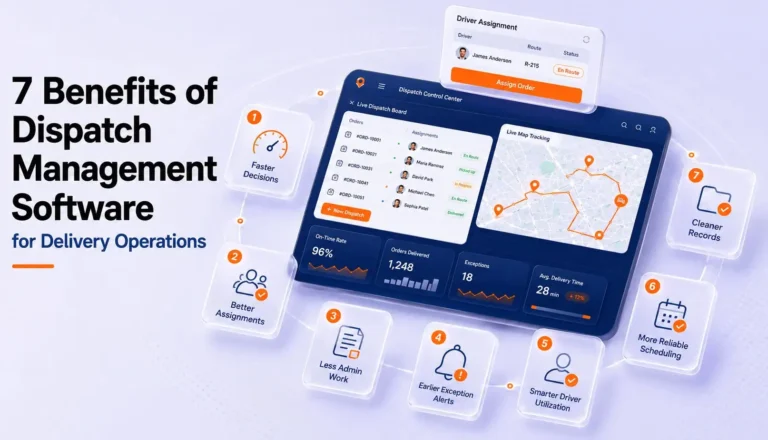
Most delivery companies do not look for dispatch software because assigning one driver to one order is difficult.
They look for it because every assignment creates additional work: checking whether the order is ready, confirming the customer’s date, balancing the driver’s workload, communicating changes, and recording what happened afterward.
The main benefits of dispatch management software come from reducing that coordination burden. Instead of forcing dispatchers to rebuild the current state from spreadsheets, calls, and messages, a structured system gives the team a clearer way to organize assignments, detect exceptions, and maintain an operational record.
Those benefits are not limited to the dispatch desk. A better assignment can also reduce driver confusion, customer-service calls, repeated delivery attempts, and administrative follow-up.
For a broader explanation of the workflow behind these systems, read our complete guide to dispatch management software.
1. Faster Dispatch Decisions Without Rushing Them
Speed matters in dispatch, but fast decisions are only useful when they are based on reliable information.
In a manual process, assigning one order may require the dispatcher to check:
- Whether the order is ready
- Which delivery date the customer accepted
- Which drivers are available
- Whether the route has enough capacity
- Whether special handling is required
- Whether another dispatcher has already changed the plan
When those details live in separate places, even a routine assignment creates unnecessary search work.
A dispatch management system brings the relevant order, driver, status, and scheduling information into one workflow. Instead of opening several files or asking multiple people for updates, the dispatcher can evaluate the order from a shared operational view.
This does not remove judgment. It removes the time spent recovering information before judgment can begin.
The result is not simply faster dispatching. It is faster decision-making with fewer missing details.
2. More Consistent Driver and Vehicle Assignments
Manual dispatching often depends heavily on the dispatcher’s personal knowledge.
An experienced dispatcher may remember which driver knows a particular area, which vehicle can handle a certain item, or which customer frequently changes delivery instructions. That knowledge is valuable, but it becomes a risk when it exists only in one person’s head.
Dispatch software helps turn informal knowledge into repeatable assignment criteria.
Depending on the operation, assignments may need to consider:
- Driver availability
- Vehicle type or capacity
- Delivery area
- Existing workload
- Customer time windows
- Handling requirements
- Driver qualifications
- Current route progress
The software can organize these factors so that similar orders are evaluated more consistently. Dispatchers can still override an assignment when the situation requires it, but the initial decision is less dependent on memory alone.
This becomes especially important as a company adds more drivers, service areas, customers, or dispatch employees.
A process that works with one experienced dispatcher may become unstable when three people are making assignments differently. A shared system creates a common operating method.
3. Less Administrative Work for Dispatchers
A large portion of dispatcher workload is not strategic decision-making. It is administrative coordination.
Dispatchers may spend hours:
- Copying order information between systems
- Searching for customer instructions
- Updating spreadsheets
- Sending individual messages to drivers
- Asking customers about available delivery dates
- Checking whether a previous message was accepted
- Rebuilding lists after a schedule changes
These tasks are necessary, but they consume the same time dispatchers need for capacity planning and exception management.
One of the practical advantages of dispatch software is that it can standardize repetitive parts of the workflow.
For example, the It’s Here Delivery Scheduler workflow documents an order pool with search, filtering, map view, multi-select tools, delivery-date offers, customer acceptance statuses, and route creation from accepted orders.
The benefit is not that every task disappears. The benefit is that the steps happen within a connected process rather than through unrelated spreadsheets, emails, and messages.
That allows dispatchers to spend less time moving information and more time making operational decisions.
4. Earlier Detection of Delivery Exceptions
A dispatch plan is only a starting point.
Drivers may become unavailable. Customers may request changes. Deliveries may take longer than expected. An urgent order may enter after routes have already been assigned.
In a fragmented process, the dispatcher may not learn about the problem until a driver calls or a customer complains.
Dispatch management software improves exception handling by making the current status of work easier to monitor.
The dispatcher can identify questions such as:
- Which orders are still unassigned?
- Which customer dates remain unconfirmed?
- Which routes have changed?
- Which deliveries are falling behind?
- Which assignments need intervention?
- Which orders must be moved to another driver?
Earlier visibility creates more options.
A delivery that appears likely to miss its window may still be reassigned or communicated proactively. A problem discovered after the delivery has already failed offers far fewer choices.
The value of visibility is therefore not the ability to watch every driver continuously. It is the ability to notice the difference between the plan and reality early enough to respond.
5. Better Use of Drivers and Vehicles
A busy driver is not necessarily a well-utilized driver.
One driver may have too many difficult stops while another has available capacity. A vehicle may have enough physical space but insufficient time to complete another delivery. A geographically convenient assignment may conflict with a customer’s accepted window.
Dispatch software gives teams a clearer way to consider workload before making assignments.
Better utilization means balancing:
- Stop count
- Service time
- Vehicle capacity
- Driver availability
- Delivery windows
- Geographic coverage
- Operational risk
The objective is not to fill every driver’s schedule to the maximum.
Plans built with no remaining flexibility are easily disrupted. One late stop can create delays across the rest of the route.
For regulated fleets, dispatch decisions may also need to account for legal operating limits. Transport Canada explains that commercial vehicle operations in Canada are governed by National Safety Code standards, including requirements related to drivers and carriers. Dispatch software can help make operational constraints visible, but it does not replace correct configuration, compliance processes, or human oversight. Review Transport Canada’s commercial driver regulations.
The real benefit is more deliberate capacity use, not simply assigning more work to each driver.
6. More Reliable Delivery Commitments
Customer expectations are often affected before the route begins.
If a delivery date is offered without considering operational capacity, the dispatcher inherits a commitment that may already be difficult to meet.
Structured dispatch and scheduling workflows connect customer availability with the operation’s ability to perform the work.
Rather than treating requested dates as disconnected notes, teams can organize:
- Available delivery days
- Customer-selected dates
- Accepted time windows
- Unavailable operating dates
- Orders waiting for confirmation
- Work ready for route creation
This is where dedicated delivery scheduling software supports the commercial scheduling process.
The benefit is not simply giving customers more choices. It is controlling which choices can be offered based on the operation’s scheduling rules.
When dispatchers can see which commitments have been offered, accepted, assigned, or changed, they are less likely to build routes around uncertain information.
That creates a more reliable handoff between customer scheduling and daily dispatch execution.
7. Cleaner Information for Customer Service and the Back Office
Dispatch decisions create consequences beyond the dispatch desk.
If an order is reassigned but the update is not recorded, customer service may give the customer outdated information. If a delivery fails without a clear status, another employee may schedule it again without understanding the original problem. If completion records are incomplete, invoicing or reconciliation may be delayed.
A connected dispatch process creates a clearer operational record.
That record can help other teams answer questions such as:
- Who was assigned to the order?
- Which delivery date did the customer accept?
- Was the assignment changed?
- What exception occurred?
- Was another attempt required?
- When did the order move to the next stage?
This reduces dependence on calls, messages, and personal explanations between departments.
The back-office benefit is not only better reporting. It is fewer situations where employees must reconstruct what happened after the fact.
How Dispatch Improvements Affect the Rest of the Operation
The benefits of dispatch management software rarely stop with the dispatcher.
| Dispatch improvement | Frontline effect | Customer effect | Back-office effect |
|---|---|---|---|
| Shared order and status view | Less time searching for information | Fewer conflicting updates | Cleaner operational records |
| Consistent assignment criteria | More balanced driver workloads | More dependable execution | Easier performance review |
| Earlier exception detection | More time to reassign or adjust work | Earlier communication | Fewer unresolved delivery cases |
| Structured scheduling workflow | Fewer uncertain commitments | Clearer delivery-date choices | Less rescheduling administration |
| Recorded assignment changes | Drivers receive current instructions | Customer service sees the latest status | Better audit trail |
| Clear completion statuses | Fewer open or ambiguous orders | Faster resolution after a failed attempt | Smoother billing and reconciliation |
This chain is important because a weak dispatch decision often creates several downstream tasks.
A poor assignment may lead to a missed window, a customer call, a failed delivery, a return to the facility, a second scheduling attempt, and a billing dispute.
Improving the original decision can prevent work across several departments.
When Dispatch Software Does Not Deliver These Benefits
Software will not automatically fix an unclear operation.
The expected benefits may not appear when:
- Order information is incomplete
- Drivers do not update statuses consistently
- Assignment rules have never been defined
- Every exception is handled outside the system
- Dispatchers maintain a separate spreadsheet “just in case”
- Customer service changes orders without updating dispatch
- The company automates a process it does not understand
A new platform can make a good dispatch process easier to scale. It can also make a poorly designed process move faster without making it more reliable.
Before implementation, the team should define:
- What makes an order ready for dispatch
- Which statuses are required
- Who can change assignments
- How customer changes enter the workflow
- Which exceptions require escalation
- What information drivers must receive
- What must be recorded when work is completed
The technology should support those decisions rather than conceal the absence of them.
How to Evaluate the Potential Benefit for Your Operation
Start by observing one normal dispatch day.
Track how often the team must:
- Search for missing order details
- Re-enter information
- Contact drivers for basic status updates
- Change assignments after routes are released
- Resolve customer-date confusion
- Ask another department what happened
- Rebuild a plan after one exception
These activities reveal where dispatch work is being consumed.
The strongest business case for dispatch software usually comes from reducing repeated coordination, not from one dramatic automation claim.
Ask three practical questions:
Where does dispatch lose time?
Look for information recovery, repeated updates, and manual communication.
Where does dispatch lose control?
Look for unassigned orders, late discoveries, conflicting statuses, and undocumented changes.
Where does dispatch create downstream work?
Look for failed commitments, repeated customer calls, rescheduling, incomplete records, and billing delays.
The answers show which dispatch software benefits matter most for your operation.
Conclusion
The main benefits of dispatch management software come from giving delivery teams a clearer way to make and manage daily decisions.
Orders are easier to evaluate. Assignments become more consistent. Dispatchers spend less time searching for information. Exceptions appear earlier. Capacity decisions become more deliberate. Customer commitments are easier to control, and the back office receives a cleaner operational record.
The software itself is not the operating model. The rules, statuses, and responsibilities still need to be defined by the business.
For teams using It’s Here, the relevant workflow is specific: orders can enter a centralized Order Pool, be searched or filtered, reviewed through Map View, moved into a Scheduler, offered to customers for date selection, and converted into routes after acceptance.
These capabilities reduce fragmented coordination. Their value still depends on the operation defining when an order is ready, who can change its status, and how exceptions should be handled.
FAQ
What Are the Main Benefits of Dispatch Management Software?
The main benefits include faster assignment decisions, more consistent driver workloads, less manual administration, earlier exception detection, better capacity visibility, more reliable delivery commitments, and clearer operational records.
Does Dispatch Software Automatically Assign Drivers?
Some systems may support automated or assisted assignment, but human oversight remains important. Dispatchers still need to handle unusual orders, incomplete information, customer priorities, and high-impact exceptions.
Can Dispatch Management Software Reduce Failed Deliveries?
It can help reduce preventable failures by improving scheduling information, assignment consistency, exception visibility, and communication. It cannot eliminate failures caused by every customer, traffic, vehicle, inventory, or access issue.
Is Dispatch Software Useful for Small Delivery Companies?
Yes, particularly when a small company begins relying heavily on spreadsheets, text messages, or one dispatcher’s memory. The value depends more on operational complexity than company size.
How Should a Company Measure Dispatch Software Performance?
Useful measures include unassigned-order aging, assignment-change rate, dispatch intervention rate, exception detection time, exception resolution time, failed-delivery recurrence, and schedule-to-execution variance.