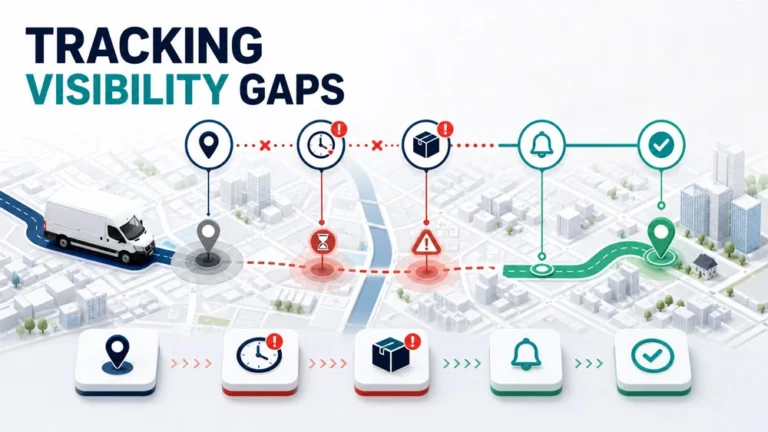
A tracking map can still leave the operation blind.
To test whether visibility is working, choose one completed order and ask dispatch, the driver, customer service, and the recipient what happened. If their answers disagree about the status, arrival time, exception, or completion evidence, the information chain is broken.
The most damaging last mile delivery tracking challenges appear when a real event does not become reliable information soon enough for someone to act. A location signal may be stale. A driver may complete a stop without updating its status. An ETA may change without reaching the customer. A delivery photo may exist but remain disconnected from the order.
This guide explains how to identify last mile delivery tracking challenges, trace their source, and apply corrective controls.
A Visibility Gap Is the Distance Between Reality and the Record
Last mile visibility depends on more than collecting location data. The operating record must follow what is actually happening in the field.
A useful tracking chain has five parts:
- Signal: The system receives a location, driver action, scan, or status update.
- Event: That input is connected to a specific order or delivery stop.
- Interpretation: The system presents a meaningful status, ETA, or exception.
- Communication: The appropriate update reaches dispatch, customer service, or the recipient.
- Action: Someone can respond in time.
A gap can form at any point. The driver’s phone may stop reporting, an event may attach to the wrong order, or an internal status may change without updating the customer.
The complete guide to last mile delivery tracking explains the full tracking workflow. Here, the focus is narrower: finding where the chain breaks and restoring a trustworthy operational view.
Visibility Gap Diagnostic
Start with symptoms rather than software labels.
| What the team observes | Likely gap | Immediate check | Corrective control |
|---|---|---|---|
| Driver appears stationary during active work | Location signal is stale or unavailable | Last update time, device status, and network availability | Display data age and define a stale signal threshold |
| Customer sees “out for delivery” for hours | Milestone is too broad or later events are missing | Status trigger and customer message rules | Use event based statuses with clear meanings |
| ETA changes sharply without an obvious cause | Inputs are incomplete or the estimate is not refreshed consistently | Stop progress, route changes, and service time assumptions | Monitor ETA variance and define when customers are notified |
| Dispatch learns about a failure from the customer | Exception did not create an internal action | Failure workflow, alert destination, and ownership | Assign exception categories, owners, and response targets |
| Delivery is complete but evidence is hard to find | Completion data is stored separately | Order history, photo, signature, notes, and timestamps | Attach required evidence to the order record |
| Two teams report different delivery states | Systems or manual records are out of sync | Source of truth and last successful update | Define one authoritative record and monitor failed data transfers |
This diagnostic prevents a common mistake: treating all last mile delivery tracking challenges as GPS problems. Status design, driver workflow, integrations, customer messaging, and exception ownership can also create blind spots.
Challenge: Stale or Inaccurate Location Data
Among the most misleading last mile delivery tracking challenges is a map without a visible update time, which can create more confidence than the data deserves.
Location accuracy and availability change with the operating environment. Buildings, bridges, trees, indoor locations, reflected signals, device quality, and atmospheric conditions can all affect the position received by a device. GPS.gov explains that real world accuracy depends on local conditions and receiver design, not only the satellite signal.
Warning Signs
- Drivers jump between locations on the map
- A vehicle remains stationary after later stops are completed
- Dispatch calls drivers to confirm whether the map is correct
- ETAs continue updating from an old position
- Location gaps cluster around particular buildings, areas, or devices
How to Fix the Gap
Show the timestamp of the latest reliable update. Define how old a signal can become before the system marks it as stale. Train drivers on device permissions, battery settings, and the correct app workflow. Give dispatch an alternative way to assess progress through stop statuses and completed events when location is temporarily unavailable.
The goal is an honest operational view that distinguishes current data from uncertain data.
Challenge: Statuses Do Not Match Real Delivery Events
One of the most common last mile delivery tracking challenges is a status that looks precise but has no consistent operational meaning.
For example, “in progress” might mean the driver accepted the route, left the facility, or arrived at the address. If drivers trigger it at different moments, the status cannot be interpreted reliably.
Build a status dictionary that defines:
- The event represented by each status
- The person or system allowed to create it
- Whether it can be changed manually
- What the customer sees
- What should happen next
Avoid adding more labels until the existing ones are understood. A smaller set of consistently triggered statuses is more useful than a detailed set that drivers and office users interpret differently.
Challenge: ETA Becomes a Promise the System Cannot Support
One of the most customer-sensitive last mile delivery tracking challenges is an ETA whose reliability users do not understand. It may depend on current location, remaining stops, route sequence, travel conditions, service duration, and changes made after release.
This visibility gap usually appears in one of three ways:
- Frozen ETA: The time does not respond to a delay or route change.
- Volatile ETA: The estimate moves so frequently that the customer cannot plan.
- Disconnected ETA: Dispatch sees a changed estimate, but the recipient continues seeing an older one.
To improve ETA control, compare the first communicated estimate, later updates, and actual arrival. Define when a material change should trigger a customer message or internal review.
Do not promise a narrow arrival window unless the operation can maintain it. A wider but well managed estimate can create more trust than false precision.
Challenge: Exceptions Are Visible but Not Actionable
One of the most operationally important last mile delivery tracking challenges is assuming that a red status alone creates an exception process.
Tracking becomes operationally useful when a deviation creates a clear decision. If a delivery is late, failed, refused, inaccessible, or missing required information, someone needs to know:
- What happened
- Which orders are affected
- Who owns the response
- What must happen next
- Whether the customer has been informed
- When escalation is required
Group exceptions by the decision they require. An incomplete address needs information. A customer absence may require rescheduling. A vehicle problem may require dispatch intervention.
For each category, define an owner and a target response time. Track both detection time and resolution time. This turns delivery visibility gaps into manageable work instead of passive dashboard warnings.
The principle also connects to dispatch quality. As explained in the guide to dispatch management mistakes, teams need to trace failures back to the earliest preventable break, not only record the final outcome.
Challenge: Customer Updates and Internal Reality Drift Apart
Some last mile delivery tracking challenges arise when operations and customers receive information from different delivery events, even though they do not need identical screens. Problems begin when each view relies on a different record.
Map every customer communication to its trigger:
| Customer message | Required event | Control question |
|---|---|---|
| Delivery confirmed | Order accepted for delivery | Is the date actually committed? |
| Reminder | Delivery remains scheduled | Has anything changed since confirmation? |
| Driver approaching | Active delivery progress supports the message | How recent is the underlying event? |
| Updated ETA | Material change to expected arrival | Does the recipient see the latest estimate? |
| Completed | Required completion action occurred | Is evidence available if the result is disputed? |
It’s Here documents branded customer alerts, delivery confirmations, night before reminders, real time ETA updates, and branded tracking links. These capabilities are most effective when each message is tied to a reliable event and the team has defined what happens when the event changes.
Challenge: Completion Evidence Is Separated From Tracking
Tracking should not stop when the driver reaches the destination.
The final state may require a timestamp, note, recipient name, photo, or digital signature. If those items live outside the order, the visibility chain ends too early.
This creates practical problems:
- Customer service cannot answer a delivery question quickly
- A dispute requires a manual investigation
- Another attempt may be scheduled without the previous context
- Reporting relies on incomplete completion data
The It’s Here delivery management software connects live shipment and driver visibility with order history, photo documentation, and digital signatures. The operational value is continuity: the evidence remains attached to the delivery record instead of becoming a separate administrative search.
Decide which evidence is mandatory for each service type. A doorstep parcel, attended furniture delivery, and installation service may require different completion controls. The driver workflow should make those requirements visible before the stop can be closed.
Challenge: Integrations Create Conflicting Sources of Truth
Real time tracking challenges can begin before the driver starts the route. If identifiers, addresses, dates, or statuses do not transfer correctly, later events may be associated with outdated information.
For every data connection, document:
- Which system creates the order
- Which identifier remains consistent
- Which system owns the current status
- How often updates move between systems
- What happens when an update fails
- Who reviews failed or duplicate records
Test the complete round trip: create an order, change it, dispatch it, complete it, and confirm that the required status returns to the correct system.
Use the official It’s Here integration options as the commercial owner for platform integration capabilities. This article should remain focused on the operational controls needed to prevent tracking gaps, not become a general guide to logistics integrations.
Run a Visibility Gap Audit With Real Orders
A controlled audit is more revealing than a polished demonstration. Select recent deliveries that include:
- One delivered late
- One rescheduled
- One failed
- One with missing or disputed evidence
- One that lost location updates
- One changed after route release
For each order, compare planned and actual events. Record when the driver acted, the system updated, dispatch noticed, the customer was informed, and the final record became available.
Then calculate four practical measures:
Data Age
How old was the location or status when someone used it to make a decision?
Detection Delay
How much time passed between the real problem and the operation recognizing it?
Communication Delay
How much time passed before the affected customer or internal team received an accurate update?
Evidence Retrieval Time
How long did it take an authorized office user to find the completion record?
These measures reveal whether the tracking process supports action.
From More Tracking Data to Better Control
Solving last mile delivery tracking challenges does not begin by collecting every possible signal. It begins by deciding which events matter, how recent the data must be, who needs each update, and what action should follow a deviation.
Start with one delivery record. Confirm that location, status, ETA, customer communication, exceptions, and completion evidence tell the same story. Where they disagree, identify the exact break in the chain and assign a corrective control.
Reliable visibility is not the promise that nothing will go wrong. It is the ability to recognize uncertainty early, communicate it honestly, and give the right person enough context to respond.
FAQ
What Causes Last Mile Delivery Tracking Challenges?
Common causes include stale location signals, inconsistent driver statuses, disconnected systems, delayed customer messages, unclear exception ownership, and completion evidence stored outside the order record.
How Can a Team Tell Whether Tracking Data Is Stale?
The system should display the time of the latest reliable update. Teams can define a threshold after which location or status data is marked as stale and should not be treated as current without another supporting event.
Why Can GPS Tracking Be Inaccurate?
Buildings, bridges, trees, indoor locations, reflected signals, device quality, and local conditions can affect the position received by a device. Mobile settings and background location limits may also affect update frequency.
How Should Delivery Exceptions Be Tracked?
Each exception should have a clear category, owner, next action, and escalation rule. Teams should measure how quickly exceptions are detected and resolved, not simply count how many occur.