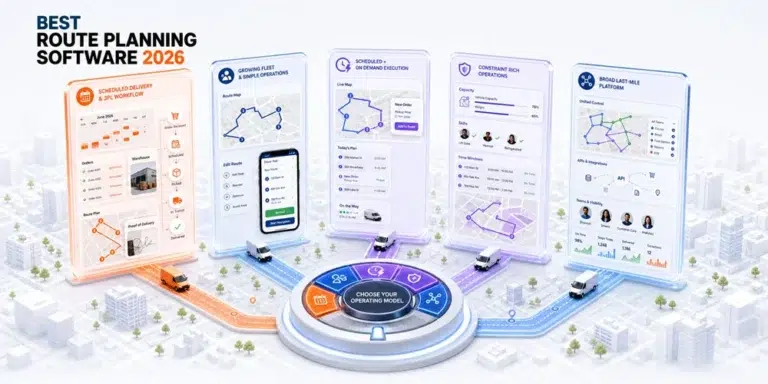
Searching for the best delivery route planning software often produces a long list of platforms with similar feature names.
Route optimization, driver apps, live tracking, customer notifications, and proof of delivery now appear across many product pages. Those labels are useful, but they do not show whether a platform fits the way a particular delivery operation accepts orders, applies constraints, reviews routes, supports drivers, and manages exceptions.
A scheduled furniture delivery operation has different needs from an on demand courier fleet. A growing local business may prioritize simple route creation and driver adoption, while a larger network may require configurable constraints, integrations, and control across several operating teams.
This guide compares five established options using their publicly documented capabilities. It does not name one universal winner. Instead, it identifies the operating environment in which each platform deserves closer evaluation.
For the fundamentals behind this software category, read our route optimization software guide.
How We Evaluated the Platforms
The comparison is based on official product information reviewed in July 2026. To identify the best delivery route planning software, we evaluated complete operating workflows rather than counting isolated feature names.
Each platform was assessed across six areas:
- Route preparation: How orders become route ready and how route drafts are created.
- Constraint support: How the software considers time windows, capacities, priorities, service time, and driver requirements.
- Dispatcher control: Whether planners can review and adjust proposed routes.
- Driver execution: How drivers receive routes, instructions, and completion requirements.
- Operational visibility: How dispatch monitors progress, ETA information, and route status.
- Operating model fit: Which type of delivery team appears most aligned with the documented workflow.
This is a research based shortlist, not a controlled laboratory test.
Before selecting a platform, buyers should require every shortlisted provider to process the same order file and exception scenario using the company’s actual constraints.
Best Delivery Route Planning Software: Quick Comparison
| Platform | Best fit based on official positioning | Notable documented capabilities | Key demo focus |
|---|---|---|---|
| It’s Here | Scheduled delivery and 3PL operations needing connected logistics workflows | Order Pool, customer date selection, multiple route drafts, manual and automated optimization, live visibility, driver app, POD, order history | Order intake through scheduling, routing, execution, and completion |
| Routific | Growing delivery businesses prioritizing route planning usability | Route optimization, editable routes, dispatcher view, driver app, tracking, notifications, POD, route insights | Route quality, dispatcher editing, driver flexibility, and reporting |
| Onfleet | Mature last mile operations with scheduled and on demand work | Configurable constraints, route optimization, auto dispatch, predictive ETA, driver workflows, tracking, POD | Constraint configuration, active route changes, and mixed delivery workflows |
| OptimoRoute | Delivery and field service teams with detailed scheduling constraints | Automated planning, workload balancing, driver and vehicle rules, mobile app, live tracking, notifications, POD | Skills, task criteria, working hours, service duration, and schedule fit |
| Route4Me | Organizations requiring broad route planning and last mile workflow coverage | Route planning, dynamic optimization, route updates, driver workflows, platform integrations | Required modules, route governance, integrations, and operating scale |
The best delivery route planning software for a particular team will be the platform whose demonstrated workflow matches its route constraints, driver process, and delivery operating model.
1. It’s Here
Best Fit: Connected Scheduled Delivery and 3PL Operations
It’s Here is a strong option for delivery businesses that need route planning to remain connected with appointment scheduling, order context, driver execution, completion evidence, and wider logistics operations.
Its documented Delivery Scheduler workflow allows teams to:
- Add orders manually or through Excel
- Organize records in a centralized Order Pool
- Search and filter orders
- Select multiple orders
- Review delivery locations through Map View
- Send customers delivery date options
- Track Not Offered, Offered, and Accepted statuses
- Create routes from confirmed orders
This workflow is especially relevant when orders should not become route ready until the customer has accepted a delivery date.
The wider platform documents:
- Manual route optimization
- Automated route optimization
- Multiple draft routes
- Real time shipment and driver visibility
- Delivery statuses
- Map tracking and live ETA
- Driver route plans
- Photo and signature proof of delivery
- Order history
- Bills of Lading, manifests, and shipping labels
The ability to combine automated route creation with manual adjustment is useful for teams that want software support without removing dispatcher control.
It’s Here also connects route planning with a broader delivery management software environment. This makes the platform particularly relevant to 3PLs and scheduled delivery businesses whose route decisions depend on customer dates, order details, additional services, completion records, and connected administrative workflows.
What to Test in a Demo
Ask the It’s Here team to demonstrate:
- An order entering the Order Pool
- A customer accepting a delivery date
- Accepted orders moving into route preparation
- More than one route draft
- Automated optimization followed by a manual adjustment
- The route from the driver’s perspective
- Live delivery visibility
- Retrieval of photo or signature proof
- Order history after completion
- Separation of clients, merchants, or service requirements
The demonstration should use the same order types and operational rules the business expects to manage after implementation.
2. Routific
Best Fit: Growing Delivery Businesses Focused on Practical Route Planning
Routific positions its platform for growing last mile delivery businesses that need route optimization, dispatch, driver tools, customer communication, and operational visibility.
Its official product information describes:
- Traffic aware route optimization
- Editable route plans
- Dispatcher timeline views
- Driver mobile workflows
- Real time driver progress
- Customer tracking links
- Delivery notifications
- Proof of delivery
- Route and driver insights
- Reporting exports
Routific’s product updates also document driver controls that can allow stops to be reordered after a route has started. This may be useful when road conditions, failed attempts, loading access, or an urgent stop require practical flexibility during execution.
The platform deserves consideration when ease of route preparation and adoption across dispatchers and drivers are central to the buying decision.
What to Test in a Demo
Ask Routific to demonstrate:
- Importing a representative order file
- Routes containing customer time windows
- Driver preferences or operational priorities
- Manual adjustments after optimization
- Reoptimization after a route change
- Driver stop reordering controls
- Customer notification timing
- Completion location and POD records
- Route and driver reporting
The test should confirm how manual changes affect ETAs, route balance, and the remaining delivery commitments.
3. Onfleet
Best Fit: Scheduled and On Demand Last Mile Execution
Onfleet is relevant to operations that need route optimization alongside active dispatch, driver execution, customer updates, and proof of delivery.
Its official route optimization documentation states that the system can consider:
- Hubs
- Delivery locations
- Customer time windows
- Driver schedules
- Vehicle capacities
- Task quantities
- Service time
- Historical traffic data
- Road speeds and restrictions
Onfleet also documents auto dispatch for on demand orders, predictive ETA information, configurable delivery zones, toll avoidance, customer notifications, and photo, signature, note, and barcode based proof of delivery.
This combination makes it a suitable candidate for teams managing scheduled work, on demand delivery, or a mixture of both.
What to Test in a Demo
Ask Onfleet to show:
- Hub and team configuration
- Driver schedules and vehicle capacities
- Custom routing constraints
- Scheduled route creation
- An on demand order entering active operations
- Dispatcher control over automated decisions
- Predictive ETA and delay handling
- Driver completion workflows
- Proof of delivery retrieval
- API based route creation when integrations are required
The buying team should understand which decisions are automated and where dispatchers can review or change the result.
4. OptimoRoute
Best Fit: Constraint Rich Delivery and Field Service Scheduling
OptimoRoute combines route planning with workforce scheduling and is relevant to delivery or field service operations that manage detailed task requirements.
Its official feature pages describe:
- Automated route and schedule planning
- Multiple driver planning
- Workload balancing
- Driver working hours
- Vehicle specific requirements
- Vehicle capacity
- Customer time windows
- Delivery priority
- Variable service duration
- Skills matching
- Coordinated orders
- Pickup and delivery workflows
- Driver mobile app
- Live tracking and ETA
- Customer notifications
- Photo, signature, and note based POD
- Route analytics
This range of constraints makes OptimoRoute worth evaluating when route planning must account for more than addresses and stop sequences.
Operations involving technicians, specialized drivers, equipment requirements, or variable service duration may find its scheduling approach particularly relevant.
What to Test in a Demo
Ask OptimoRoute to process orders containing:
- Different driver skills
- Vehicle specific requirements
- Customer time windows
- Variable task duration
- Coordinated orders
- Pickup and delivery relationships
- An urgent order added during execution
- A route with uneven workloads
Review how the system balances work and what happens when every constraint cannot be satisfied at the same time.
5. Route4Me
Best Fit: Broad Last Mile Route Planning Requirements
Route4Me positions its product as a last mile transportation platform serving route planners, dispatchers, drivers, and operations managers.
Its current official materials describe capabilities such as:
- Route planning and optimization
- Multiple vehicle route planning
- Dynamic route optimization
- Route updates and reoptimization
- Route export
- Driver workflows
- Weighted stop priorities
- Multiple customer time windows
- Unrouted stop handling
- API access
- Connected last mile workflows
Route4Me may be a relevant candidate for organizations that need a broad platform and want to configure route planning around several operational roles or use cases.
Because the platform covers a wide range of last mile functions, the evaluation should focus carefully on the exact workflow and configuration required by the buyer.
What to Test in a Demo
Ask Route4Me to demonstrate:
- Multi vehicle route creation
- Weighted delivery priorities
- Multiple time windows
- Stops that cannot be assigned
- Updating and reoptimizing an active route
- Driver access to route information
- Required operational reports
- Data export
- API or integration requirements
- User roles for planners, dispatchers, drivers, and managers
The demo should show the complete workflow rather than presenting capabilities as separate platform modules.
Which Platform Fits Your Operating Model?
Choosing the best delivery route planning software becomes easier when the business first defines whether scheduling, route usability, active dispatch, complex constraints, or broad platform coverage is its main priority.
The best delivery route planning software depends on how the operation creates and executes delivery work.
Choose a Scheduling Led Workflow When
- Customers must select or accept delivery dates
- Confirmed dates determine which orders become route ready
- Routes depend on appointment commitments
- The business manages additional delivery services
- Delivery records connect to wider 3PL operations
It’s Here deserves close consideration for this type of workflow because its documented process connects customer date selection, route creation, driver execution, live visibility, and completion records.
Choose a Route Planning Led Workflow When
- Route preparation is the primary operational bottleneck
- Planners need straightforward editing controls
- Drivers need clear mobile routes
- Customer tracking and notifications are required
- The operation wants accessible route and driver reporting
Routific is a relevant candidate for growing delivery businesses with this priority.
Choose an Active Dispatch Led Workflow When
- Scheduled and on demand orders share the same operation
- New work may enter during the delivery day
- Dispatch needs predictive ETA information
- Drivers and customers require current updates
- Automated dispatch decisions need defined controls
Onfleet should be considered for this environment.
Choose a Constraint Led Workflow When
- Driver skills affect assignment
- Vehicles have specialized requirements
- Service duration varies significantly
- Delivery and field service work overlap
- Working hours and workload balance are central
OptimoRoute may align well with this operating model.
Choose a Broad Platform Evaluation When
- Several operational teams use the routing environment
- The business needs dynamic route changes
- Weighted priorities and multiple windows are important
- API access is a central requirement
- The organization needs broad last mile workflow coverage
Route4Me is worth including in the shortlist.
How to Compare the Shortlisted Platforms
Do not select the best route optimization software for delivery from the feature table alone. A controlled demonstration is more useful when selecting the best delivery route planning software because every provider must respond to the same orders, constraints, and route exceptions.
Before scheduling vendor demonstrations, review our guide on how to choose route optimization software to build a weighted checklist and prepare one consistent test scenario for every shortlisted platform.
Prepare one test file containing:
- An incomplete address
- Two customer time windows
- Two vehicle capacities
- One priority delivery
- One order with special service requirements
- One driver absence
- One customer change
- One order added after route creation
- One incomplete delivery
- One delivery requiring photo or signature proof
Ask every provider to complete the same workflow:
- Import and validate the orders
- Apply the operational constraints
- Create route drafts
- Explain the proposed route
- Make a dispatcher adjustment
- Release work to a driver
- Introduce an active route exception
- Update the customer or ETA
- Complete the delivery
- Retrieve the completion record
A consistent scenario gives the buying team better evidence than separate demonstrations built around each vendor’s ideal sample data.
Final Recommendations by Use Case
| Use case | Platform to evaluate closely |
|---|---|
| Scheduled delivery connected with route preparation and wider 3PL workflows | It’s Here |
| Growing delivery business prioritizing route usability | Routific |
| Scheduled and on demand last mile execution | Onfleet |
| Detailed driver, vehicle, task, and service constraints | OptimoRoute |
| Broad last mile platform and route configuration requirements | Route4Me |
| Customer accepted dates moving directly into route creation | It’s Here |
| Manual and automated route optimization in one connected workflow | It’s Here |
| Field service and delivery scheduling in the same operating model | OptimoRoute |
These recommendations are starting points for a shortlist, not automatic purchase decisions.
Which Platform Fits Your Delivery Operation?
There is no universal best delivery route planning software for every last mile team.
It’s Here is particularly relevant when route planning must connect with customer scheduling, order context, multiple route drafts, dispatcher control, driver execution, live visibility, POD, and wider 3PL workflows.
Routific offers a route planning focused environment for growing delivery businesses. Onfleet combines route optimization with scheduled and on demand execution. OptimoRoute supports detailed delivery and workforce scheduling constraints. Route4Me provides broad route planning and last mile platform capabilities.
The final decision should come from a controlled demonstration using the buyer’s own orders and operating rules.
Define the workflow, identify essential constraints, test the same exception scenario across every shortlisted platform, involve dispatchers and drivers, and verify that the product can preserve accurate order information from route preparation through completion.
FAQ
What Is the Best Delivery Route Planning Software?
The best option depends on the operating model. Scheduled delivery, on demand work, field service, complex constraints, 3PL workflows, and growing local fleets require different route planning capabilities.
Which Route Planning Software Is Suitable for Scheduled Deliveries?
It’s Here is relevant when customers must accept delivery dates before orders move into route creation. OptimoRoute may also be evaluated when detailed scheduling and task constraints are central.
Which Platform Supports Manual and Automated Route Optimization?
It’s Here officially documents both manual and automated route optimization as well as multiple draft routes for dispatcher review.
How Should Last Mile Teams Compare Route Planning Software?
Use the same order file, constraints, driver scenario, route change, incomplete delivery, and completion requirement for every shortlisted provider.
Should Drivers Participate in the Selection Process?
Yes. Drivers should test route access, stop information, navigation handoff, status updates, exception reporting, and proof of delivery tools before the final decision.