A dispatch software proposal may promise fewer manual tasks, more efficient routes, and better delivery visibility. None of those claims establishes a financial return on its own.
The business case begins with a different question:
Which measurable costs or capacity constraints will change after implementation?
Calculating dispatch software ROI means comparing the financial value of those changes with the full cost of buying, implementing, and operating the system. It requires a baseline, realistic assumptions, and a clear distinction between time saved and money actually recovered.
For a broader explanation of the workflow being evaluated, read our complete guide to dispatch management software.
Dispatch Software ROI Starts With a Baseline
ROI cannot be calculated from a software feature list. A reliable dispatch software ROI estimate must begin with measured operating costs rather than assumed improvements.
Before reviewing potential savings, measure how dispatch currently operates. Use a representative period typically several weeks or months—and document:
- Dispatcher hours spent organizing and assigning work
- Time spent confirming delivery dates
- Time spent searching for order information
- Route planning and adjustment time
- Driver overtime
- Failed or repeated delivery attempts
- Customer service calls related to delivery status
- Administrative time spent recovering proof or reconstructing events
- Orders handled per dispatcher
- Delivery volume the current team can support
The baseline should reflect normal operations, not the company’s best or worst week.
It should also separate problems dispatch software may influence from costs it cannot reasonably control. For example, software may improve access to delivery instructions, but it cannot prevent every customer absence, traffic delay, weather event, or vehicle failure.
The benefits of dispatch management software become financially relevant only when they can be connected to an observable change in this baseline.
Build the ROI Model Around Cost Drivers
A useful ROI model traces each proposed benefit through four elements:
| Cost driver | Baseline to collect | Evidence after implementation | Financial conversion |
|---|---|---|---|
| Dispatch coordination | Hours spent searching, updating, and communicating | Reduction in hours per week | Hours reduced × loaded hourly cost |
| Route preparation | Time required to create and revise routes | Change in planning time | Hours reduced × planner cost |
| Driver overtime | Monthly overtime hours or expense | Reduction after rollout | Actual overtime expense avoided |
| Repeated deliveries | Attempts caused by preventable scheduling or information issues | Reduction in qualifying attempts | Attempts avoided × cost per attempt |
| Customer service work | Calls or cases related to delivery status | Change in volume and handling time | Hours reduced × loaded labor cost |
| Documentation recovery | Time spent locating signatures, photos, or order history | Reduction in administrative work | Hours reduced × administrative cost |
| Operational capacity | Maximum volume handled without adding staff | Additional volume absorbed | Avoided hire or contribution margin, when defensible |
This cost driver approach keeps the dispatch software ROI model connected to changes the operation can measure after implementation.
Do not assign a dollar value to a benefit merely because it sounds valuable.
“Better visibility” becomes a financial benefit only when it reduces something measurable, such as status calls, dispatcher follow up, administrative recovery time, or preventable overtime.
Step 1: Calculate the Full Investment Cost
The software subscription is only one part of the investment.
A first year calculation may need to include:
Recurring costs
- Software subscription
- Paid modules or additional users
- Support plans
- Messaging or transaction charges
- Mobile data or device expenses
- Ongoing integration costs
One time costs
- Setup and onboarding
- Data preparation
- Integration work
- Configuration
- Training
- Internal project management time
- Temporary parallel operation
- Process documentation
- Change management activities
Use the vendor’s current quote rather than a public starting price when building the final business case. Pricing may vary by volume, users, modules, services, and implementation requirements.
The basic calculation is:
First Year Investment Cost = One Time Costs + First Year Recurring Costs
For later years, remove one time costs unless another implementation phase is planned.
Step 2: Identify Benefits That Can Be Measured
Dispatch software may create value through labor efficiency, avoided operating costs, or additional capacity.
These categories should remain separate.
Labor efficiency
Examples include less time spent:
- Searching for order details
- Moving information between systems
- Collecting customer availability
- Updating spreadsheets
- Calling drivers for routine status updates
- Recovering proof of delivery
- Reconstructing assignment changes
Saved time is not automatically a cash saving.
If a dispatcher saves ten hours each week but payroll remains unchanged, the company has created capacity rather than reduced expense. That capacity may still be valuable if it absorbs growth, reduces overtime, improves exception handling, or delays another hire.
Avoided operating costs
Examples may include:
- Qualifying driver overtime
- Preventable repeat delivery attempts
- Manual messaging expenses
- Paper documentation
- Administrative recovery work
Only include costs that can reasonably be linked to the new workflow.
Additional operational capacity
A dispatch team may be able to manage more orders without adding the same amount of administrative labor.
This benefit should be valued carefully.
Do not multiply every additional order by total revenue. Use either:
- The contribution margin from additional volume that can realistically be won and fulfilled
- The cost of a hire that can genuinely be delayed or avoided
Capacity with no demand has no immediate financial value.
Step 3: Connect Verified Features to Testable Hypotheses
A product capability should enter the ROI model as a hypothesis, not a guaranteed saving.
Within It’s Here, several verified workflows can be connected to measurable operational questions.
Order Pool and scheduling workflow
The Scheduler includes manual and Excel order entry, Search, filtering, Multi Select, Map View, customer date offers, Accepted statuses, and route creation from confirmed orders.
A company evaluating these capabilities could measure:
- Time spent preparing orders for scheduling
- Time spent collecting customer availability
- Number of manual scheduling contacts
- Orders requiring correction before route creation
- Administrative time per confirmed delivery date
The official Delivery Scheduler user guide documents this workflow.
A structured delivery scheduling software process may reduce fragmented coordination, but the actual value depends on current order volume, response rates, staffing, and workflow adoption.
Route preparation
The Delivery Management platform documents Manual and Automated Route Optimization and Multiple Draft Routes.
Relevant measurements may include:
- Route planning time
- Time spent revising drafts
- Number of routes manually rebuilt
- Planned versus actual route performance
- Dispatcher intervention after route release
Do not assume a fuel or mileage saving before comparing actual route data.
Execution visibility and completion records
The platform also documents real time shipment and driver visibility, live ETA information, a Driver App, Order History, and digital photo and signature proof of delivery.
Possible measurements include:
- Status related customer calls
- Dispatcher calls to drivers
- Time spent retrieving completion evidence
- Orders closed without adequate documentation
- Administrative time spent investigating a delivery
These are measurement opportunities, not guaranteed performance claims.
Step 4: Use a Transparent ROI Formula
A practical first year formula is:
Dispatch Software ROI (%) = [(Total First Year Benefits − Total First Year Costs) ÷ Total First Year Costs] × 100
The Business Development Bank of Canada describes ROI as a financial ratio used to evaluate the return generated by an investment. Its ROI overview also reinforces the importance of understanding which earnings and investment values are being used.
Keep the period consistent. Do not compare three years of benefits with one year of costs.
A Hypothetical Dispatch Software ROI Example
A hypothetical dispatch software ROI example can show how the calculation works without presenting the result as an industry benchmark or customer outcome.
The following example is illustrative. It does not represent an It’s Here customer result or an industry benchmark.
Assume a regional delivery operation identifies these potential monthly changes:
| Benefit category | Hypothetical monthly change | Monthly value |
|---|---|---|
| Dispatch coordination | 40 hours × $35 | $1,400 |
| Repeat attempts avoided | 6 attempts × $110 | $660 |
| Administrative recovery | 12 hours × $30 | $360 |
| Overtime avoided | Actual reduction | $400 |
| Total monthly benefit | $2,820 |
The estimated annual gross benefit is:
$2,820 × 12 = $33,840
Now assume the first year costs are:
| Cost category | Hypothetical cost |
|---|---|
| Setup and configuration | $5,000 |
| Data preparation and integration | $3,500 |
| Training and internal project time | $2,500 |
| First year subscription | $14,400 |
| Total first year cost | $25,400 |
The first year net benefit is:
$33,840 − $25,400 = $8,440
The first year ROI is:
($8,440 ÷ $25,400) × 100 = 33.2%
This result is only as reliable as the assumptions behind it.
If the company cannot verify the 40 hours of coordination work or the true cost of a repeated delivery, those inputs should be tested before the investment is approved.
How to Calculate the Payback Period
ROI shows the return relative to investment. Payback estimates how long it takes cumulative benefits to recover the initial cost.
A simplified formula is:
Payback Period = One Time Implementation Costs ÷ Monthly Net Benefit After Recurring Costs
Using the hypothetical example:
- One time costs: $11,000
- Monthly gross benefit: $2,820
- Monthly subscription: $1,200
- Monthly net benefit: $1,620
The simplified payback period is:
$11,000 ÷ $1,620 = approximately 6.8 months
This calculation assumes the full benefit begins immediately.
A more conservative model should account for:
- Training time
- Gradual user adoption
- Data cleanup
- Parallel workflows
- Seasonal volume
- Delayed integrations
- A stabilization period after launch
If the expected benefit ramps up over three months, calculate each month separately rather than claiming immediate payback.
Avoid Counting the Same Benefit Twice
Double counting is one of the most common problems in software ROI proposals.
Suppose route preparation saves a dispatcher ten hours each week.
You should not count all three of the following unless they are genuinely separate:
- Labor cost saved
- Overtime avoided
- Additional capacity created
The same ten hours cannot simultaneously reduce payroll, eliminate overtime, and support extra volume unless the operational evidence shows each effect independently.
Other common overlaps include:
- Counting fewer status calls as both dispatcher and customer service savings without separating ownership
- Counting a repeated delivery as fuel, labor, vehicle, and full delivery cost when those values already overlap
- Counting an avoided hire and the full labor time saved by the same employees
- Counting revenue growth without subtracting the cost of serving the additional orders
Choose the most defensible financial treatment for each benefit.
Use Three Scenarios Instead of One Forecast
A single ROI percentage can create false certainty.
Build three cases:
Conservative case
Include only benefits supported by strong baseline data and cautious improvement assumptions.
Expected case
Use changes the operations team believes are achievable after adoption stabilizes.
Upside case
Include additional capacity or cost reductions that require strong adoption and process improvement.
For example:
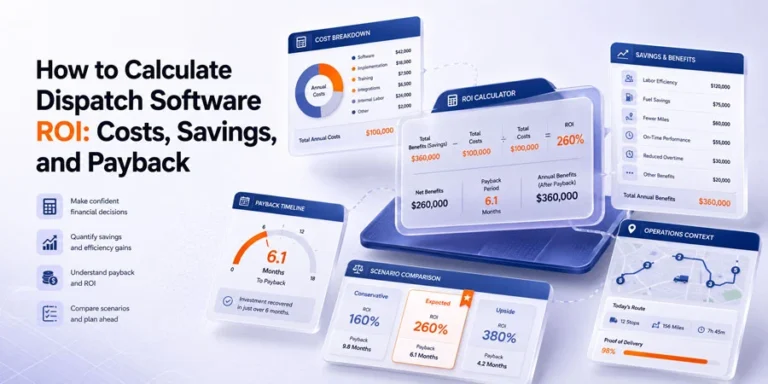
| Scenario | Annual benefit | First-year cost | First-year ROI |
|---|---|---|---|
| Conservative | $22,000 | $25,400 | -13.4% |
| Expected | $33,840 | $25,400 | 33.2% |
| Upside | $45,000 | $25,400 | 77.2% |
These numbers are hypothetical.
The value of the table is not the percentages themselves. It shows management which assumptions must be true for the investment to succeed.
Measure ROI After Implementation
A business case should become a measurement plan. Actual dispatch software ROI should be reviewed against the original baseline after adoption and workflow stabilization.
Before launch, assign an owner and data source to every benefit.
| Metric | Baseline owner | Post launch source | Review frequency |
|---|---|---|---|
| Dispatch coordination hours | Dispatch manager | Time study or workflow sample | Monthly |
| Scheduling contacts | Customer service or dispatch | Message and activity records | Monthly |
| Route preparation time | Route planner | Planning logs | Weekly |
| Repeated delivery attempts | Operations | Order history | Monthly |
| Driver overtime | Payroll or fleet manager | Payroll records | Monthly |
| Proof recovery time | Administration | Case sample | Monthly |
| Status related calls | Customer service | Call categories | Monthly |
Review performance at:
- 30 days for adoption issues
- 60 to 90 days for process stabilization
- Six months for early financial results
- Twelve months for the full first year ROI
When results differ from the proposal, determine whether the issue is:
- Weak adoption
- Incorrect configuration
- Poor baseline data
- Unrealistic assumptions
- A workflow that was never changed
- A feature that did not solve the expected problem
Software cannot produce a return when the old process continues beside it indefinitely.
Questions to Ask Before Approving the Investment
Use the dispatch scheduling software features checklist to confirm product fit, then ask:
- Which three operating costs are expected to change?
- What is the measured baseline for each one?
- Which verified feature is expected to create the change?
- Who owns implementation and adoption?
- Which benefits create cash savings and which create capacity?
- Which one time and recurring costs are included?
- What happens if benefits take six months to stabilize?
- Which assumptions would make the investment unprofitable?
- How will overrides, failed deliveries, and manual workarounds be measured?
- When will management review the result?
A vendor can help explain the product. The operation must own the assumptions.
Conclusion
A credible dispatch software ROI calculation does not begin with a promised percentage.
It begins with the current cost of dispatch coordination, repeated work, overtime, incomplete documentation, and constrained capacity. The business then estimates which costs may change, includes the complete investment, and tests the result under conservative and expected scenarios.
Verified capabilities such as order organization, customer date collection, route preparation, real time visibility, driver workflows, and proof of delivery can support measurable improvement. Their financial value depends on the company’s baseline, implementation quality, and adoption.
The strongest business case is not the one with the highest projected return. It is the one whose assumptions can still be measured after the software goes live.
FAQ
How Do You Calculate Dispatch Software ROI?
Subtract total software and implementation costs from quantified financial benefits, divide the result by total costs, and multiply by 100. Use benefits and costs from the same measurement period.
What Costs Should Be Included in Dispatch Software ROI?
Include subscription fees, onboarding, configuration, integrations, data preparation, training, internal project time, devices, support, and any temporary parallel operation.
Is Time Saved Considered a Financial Benefit?
Time saved creates financial value when it reduces overtime, avoids a hire, supports additional profitable volume, or allows employees to complete other necessary work. It should not automatically be treated as a payroll reduction.
What Is a Good Payback Period for Dispatch Software?
There is no universal target. The acceptable period depends on cash flow, implementation risk, contract length, confidence in the benefits, and the company’s alternative investment opportunities.
How Long Should Dispatch Software ROI Be Measured?
Track adoption during the first 30 to 90 days, review early financial effects around six months, and complete a full first year comparison after twelve months.