The morning route plan may look complete, but the real work begins when drivers leave the facility.
A customer changes an access instruction. One stop takes longer than expected. A driver reports that a delivery cannot be completed. Another route finishes early enough to absorb additional work. Meanwhile, dispatch needs to understand which commitments are still realistic and which customers require an update.
This is the practical context for understanding how delivery route management software works. It does more than arrange stops on a map. It helps delivery teams turn order data into executable routes, share current information with drivers, monitor progress, manage changes, and preserve a reliable record of completion.
For the optimization principles behind route creation, read our route optimization software guide.
What Is Delivery Route Management Software?
Delivery route management software helps an operation prepare, release, monitor, and review the routes used to complete deliveries.
It connects several parts of the daily workflow:
- Orders that are ready for delivery
- Customer addresses and instructions
- Delivery dates and time windows
- Available drivers and vehicles
- Route drafts and stop sequences
- Current delivery statuses
- Driver progress
- Exceptions and incomplete deliveries
- Proof of delivery and order history
Route optimization is one important part of this process, but route management has a broader operational role.
Optimization searches for a suitable way to group and sequence stops under defined constraints. Route management helps the team use that result during the delivery day and respond when actual execution differs from the original plan.
A route can be mathematically efficient and still fail operationally if the driver receives incomplete instructions, the wrong vehicle is assigned, a customer commitment is missing, or dispatch cannot see that the route has fallen behind.
How Delivery Route Management Software Works Across the Delivery Day
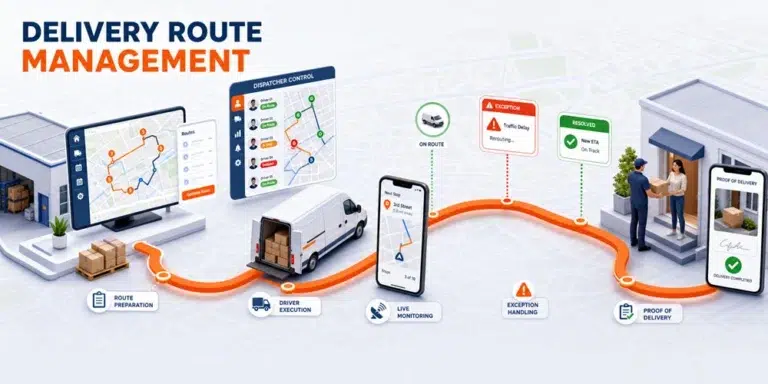
The clearest way to understand how delivery route management software works is to follow a route from order selection through completion.
| Stage | Main operational question | Route management responsibility | Expected output |
|---|---|---|---|
| 1. Prepare | Which orders are ready to route? | Organize and validate delivery information | A reliable order pool |
| 2. Build | How should stops be grouped and sequenced? | Create route drafts using relevant constraints | A feasible route plan |
| 3. Review | Does the proposed route make operational sense? | Let dispatch inspect and adjust the plan | An approved route |
| 4. Release | Does the driver have the current information? | Send the route and stop details into execution | A driver ready route |
| 5. Monitor | Is actual progress matching the plan? | Display locations, statuses, and ETA information | A shared current view |
| 6. Respond | What should happen when conditions change? | Support informed operational intervention | An updated response |
| 7. Close | What happened at each stop? | Preserve status, evidence, and order history | A usable delivery record |
Each stage reduces a different type of uncertainty.
Before route creation, the team needs confidence in the orders. Before release, dispatch needs confidence in the route. During execution, the operation needs confidence in the current status. After delivery, the business needs confidence in the completion record.
1. It Creates a Reliable Starting Point for Route Planning
Route quality depends on the information available before planning begins.
A delivery order may require:
- A valid address
- A confirmed delivery date
- A customer time window
- Contact information
- Access instructions
- Item details
- Vehicle or capacity requirements
- Service requirements
- Delivery priority
- Supporting documents
If these details are stored across spreadsheets, emails, and customer service notes, route preparation begins with information recovery.
The planner must first determine which version of the order is current. That creates delay and increases the chance that a route will be built around incomplete information.
A structured route management workflow gives the team a shared order pool from which eligible deliveries can be selected.
The purpose is not simply to store more data. It is to ensure that the information used to create the route remains connected to the order as it moves into execution.
2. It Turns Delivery Constraints Into a Feasible Plan
The shortest route is not always the most useful route.
A last mile operation may need to consider:
- Customer time windows
- Vehicle capacity
- Driver availability
- Delivery priority
- Service duration
- Starting and ending locations
- Driver or vehicle qualifications
- Pickup and delivery relationships
- Additional services at the stop
- Previously accepted customer commitments
These conditions define whether a route is feasible.
Google’s official vehicle routing documentation explains that routing problems may include multiple vehicles as well as capacity and time window constraints. It also shows why the meaning of an “optimal” route depends on the objective selected by the operation.
One business may prioritize total distance. Another may need to balance driver workloads or protect narrow appointment windows.
Delivery route management software helps translate those operating requirements into route inputs. The resulting plan should reflect the work the business actually needs to perform, not only the geographic location of each stop.
3. It Gives Dispatchers More Than One Route Draft
A proposed route should be treated as a decision that can be reviewed.
The routing process may produce a plan that satisfies the available data but does not account for information held by an experienced dispatcher.
For example, dispatch may know that:
- A loading location is difficult to access at a certain time
- One customer regularly requires additional service time
- A particular driver is better suited to a complex delivery
- A road appears available on the map but is impractical for a large vehicle
- One order should remain with a specific client or service group
This is where manual control remains valuable.
The verified capabilities of It’s Here include multiple draft routes as well as manual and automated route optimization. Automated optimization can support repeatable planning work, while manual adjustment lets dispatchers apply operational context before the route is released.
This combination matters because route planning is rarely a choice between software and human knowledge. Software can evaluate many possible route combinations, while dispatchers can review conditions that may not be fully represented in the data.
4. It Creates a Clear Handoff From Dispatch to the Driver
A route is not ready merely because its stops have been sequenced.
The driver also needs enough context to execute each delivery correctly.
That may include:
- The current stop order
- Customer contact details
- Delivery instructions
- Time window information
- Additional service requirements
- Item or package information
- Required completion evidence
- Notes about access or previous attempts
When this information reaches the driver through several channels, the route can separate from the order details used to build it.
The address may appear in one app, the access code in a message, and the revised time window in an email. Dispatch believes it released a complete plan, but the driver receives only part of it.
A connected driver workflow reduces that gap.
It’s Here documents a driver app with access to route plans and tools for capturing photo and signature proof of delivery. This keeps route execution and delivery evidence connected to the wider delivery management software workflow.
5. It Shows Whether Execution Still Matches the Plan
Understanding how delivery route management software works also requires distinguishing between planned and actual progress.
A route may be scheduled to reach Stop 6 at 2:00 p.m. That expectation becomes less reliable if an earlier delivery takes longer than planned, a driver encounters an access problem, or traffic changes during the day.
Without current visibility, dispatch may not discover the problem until:
- The driver calls for help
- A customer contacts the office
- Several later stops have already been affected
- The route returns with incomplete deliveries
Route visibility gives the team an earlier opportunity to respond.
The It’s Here platform documents real time shipment and driver visibility, current delivery statuses, map tracking, and live ETA information. These capabilities help dispatch compare planned execution with the route’s current state.
The value is not in watching a vehicle icon move across a map. The value is in recognizing a meaningful difference early enough to make a useful decision.
6. It Supports Better Responses to Route Exceptions
No route management system can prevent every delivery problem.
Customers may be unavailable. Vehicles can become unavailable. Traffic and weather can affect travel. Addresses may be incorrect. A delivery may require more time or equipment than expected.
Software supports exception management by helping dispatch answer four questions.
What happened?
The team needs a clear status or signal that actual execution has changed.
Which work is affected?
A delay at one stop may affect only that delivery, or it may place every later commitment on the route at risk.
What information is available?
Dispatch may need the driver’s current location, remaining stops, customer windows, route workload, and the availability of other drivers.
What action is appropriate?
The response may involve customer communication, a route adjustment, reassignment, rescheduling, or documenting an incomplete attempt.
Delivery route management software does not make every exception decision automatically. Its role is to reduce the time spent reconstructing the situation so the dispatcher can act from a shared and current view.
7. It Connects Route Completion With Operational Records
A route is not fully closed when the vehicle returns to the facility.
The business may still need to know:
- Which deliveries were completed
- Which stops were unsuccessful
- When each delivery occurred
- Whether a photo or signature was collected
- Which notes the driver recorded
- Whether another attempt is required
- Whether the customer commitment was met
- Which documents support the completed service
If completion information remains on a driver’s phone or inside a message thread, the office must search for evidence whenever a customer or client asks a question.
It’s Here documents order history, delivery statuses, digital photographs, signatures, Bills of Lading, manifests, and shipping labels within its delivery workflow.
These records allow route activity to support customer service, operational review, and documentation after the delivery day has ended.
Route Optimization and Route Management Are Not the Same
The two functions work together, but they answer different questions.
| Function | Primary question | Main output |
|---|---|---|
| Route optimization | What grouping and sequence best meets the selected objective and constraints? | A proposed route plan |
| Route management | How will the route be prepared, released, monitored, adjusted, and closed? | A controlled execution workflow |
| Dispatch management | Who owns the work, and what action is needed when conditions change? | Assignment and exception decisions |
| Delivery scheduling | When can the delivery be promised or accepted? | A confirmed date or time window |
| Delivery management | How is the wider delivery lifecycle controlled? | An end to end operational record |
Keeping these boundaries clear reduces process confusion and protects the keyword ownership of the site’s commercial landing pages.
This distinction also clarifies how delivery route management software works alongside optimization, scheduling, dispatch, and the wider delivery-management process.
This article explains how routing supports last mile execution. It does not replace the broader guide to route optimization or the commercial page covering the complete delivery management platform.
A Route Readiness Check Before Release
A practical way to evaluate how delivery route management software works is to check whether each route is genuinely ready before it reaches the driver. A practical way to evaluate how delivery route management software works is to check whether each route is operationally ready before it reaches the driver. Before sending a route to a driver, dispatch should confirm five areas.
Order readiness
- Are all stops eligible for delivery?
- Are addresses and contact details complete?
- Are changes reflected in the current order record?
Customer commitments
- Are accepted dates and time windows visible?
- Are access instructions included?
- Does any stop require customer attendance?
Driver and vehicle fit
- Is the assigned driver available?
- Can the vehicle support the order requirements?
- Are special services or qualifications required?
Route feasibility
- Does the stop sequence respect operational constraints?
- Is there enough time for expected service duration?
- Has dispatch reviewed unusual stops?
Completion requirements
- Does the driver know what evidence is required?
- Are photos, signatures, notes, or documents needed?
- Is the failure process clear if delivery cannot be completed?
This check is more useful than asking whether the route has merely been “optimized.” It tests whether the plan is ready to survive contact with the delivery day.
Metrics That Reveal Route Management Quality
Route distance alone cannot show whether the complete process is working.
Useful measures include:
Route change rate
How often are routes changed after approval or release?
Frequent changes may indicate weak input data, unstable customer commitments, or unrealistic initial planning.
On time route release
Are drivers receiving approved routes early enough to prepare and begin work as expected?
Time window compliance
How often are deliveries completed within the accepted customer window?
Dispatch intervention rate
How many active routes require manual involvement from dispatch?
Exception detection time
How long passes between a problem occurring and the office becoming aware of it?
Incomplete delivery recurrence
Are the same locations, order types, instructions, or service conditions repeatedly causing failures?
Proof completion rate
Are required photos, signatures, notes, and documents captured consistently?
Together, these measures show whether route management is creating stable plans, visible execution, and reliable completion records.
Conclusion
The main value of route management appears after a collection of orders becomes an active delivery plan.
Understanding how delivery route management software works means following the entire operational chain: order preparation, constraint based route creation, dispatcher review, driver handoff, live visibility, exception response, and delivery closure.
Route optimization supports the plan, but route management keeps that plan connected to the people and information required to execute it.
For last mile teams, the goal is not to produce a perfect map at the beginning of the day. It is to create feasible routes, give drivers current information, identify problems early, and preserve a dependable record of what actually happened.
FAQ
How Does Delivery Route Management Software Work?
Delivery route management software organizes route ready orders, applies operating constraints, creates route drafts, supports dispatcher review, sends current route information to drivers, monitors progress, and records delivery outcomes.
Is Route Management the Same as Route Optimization?
No. Route optimization searches for a suitable grouping and sequence of stops. Route management covers the wider process of preparing, releasing, monitoring, adjusting, and closing those routes.
Can Dispatchers Manually Adjust Optimized Routes?
That depends on the product. It’s Here documents both automated and manual route optimization, allowing dispatchers to review and adjust proposed routes when operational context requires it.
What Information Should Drivers Receive With a Route?
Drivers may need the current stop sequence, customer details, delivery instructions, time windows, service requirements, item information, and the evidence required to complete each stop.
Which Metrics Should Last Mile Teams Track?
Useful measures include route change rate, on time release, time window compliance, dispatch intervention, exception detection time, incomplete delivery recurrence, and proof completion.