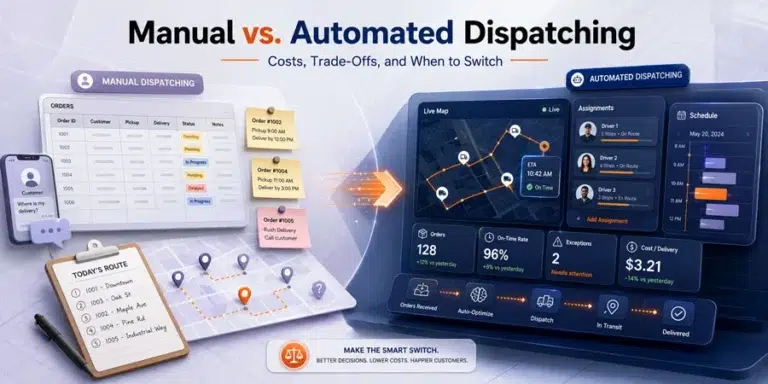
The manual vs automated dispatching debate usually begins with the wrong question.
Teams ask whether software should replace the dispatcher. A better question is which decisions are repetitive enough to standardize and which ones still depend on incomplete information, customer context, or operational judgment.
A routine order with a confirmed date, known service area, and standard requirements may fit a documented rule. A delivery involving unusual equipment, a priority customer, and conflicting time windows may not.
That is the practical difference in manual vs automated dispatching. The decision is not between people and software. It is about assigning the right type of work to each.
For a broader explanation of the complete dispatch workflow, read our guide to dispatch management software.
What Is Manual Dispatching?
A manual dispatching process relies primarily on people to review incoming work, select drivers or vehicles, update assignments, and communicate changes.
The tools may include:
- Spreadsheets
- Whiteboards
- Shared calendars
- Phone calls
- Text messages
- Printed route sheets
- Basic mapping applications
“Manual” does not necessarily mean disorganized.
An experienced dispatcher may use a well-maintained spreadsheet, documented service-area rules, and consistent driver communication. In a small operation with predictable work, that system may be entirely appropriate.
The real limitation is that the dispatcher must personally gather information, evaluate constraints, update records, and communicate each decision.
As volume or complexity increases, the process becomes harder to maintain without errors or delays.
What Is Automated Dispatching?
Automated dispatching uses software rules, system data, or algorithms to support or execute repeatable dispatch decisions.
Automation can operate at several levels.
Rules-Based Dispatching
The system applies predefined conditions.
For example, an order may be grouped by service area, scheduled date, vehicle requirement, or driver availability.
Assisted Dispatching
The software organizes information or recommends an assignment, but a dispatcher reviews the decision before releasing it.
Automated Assignment
The system assigns eligible work when defined conditions are met. Dispatchers supervise the process and intervene when an exception falls outside the rules.
These approaches should not be confused with removing humans from dispatch.
Automated dispatching software works best when routine decisions move through clear rules while dispatchers retain control over unusual, incomplete, or commercially sensitive situations.
Manual vs Automated Dispatching at a Glance
| Decision factor | Manual dispatching | Automated dispatching |
|---|---|---|
| Initial setup | Usually quick and inexpensive | Requires configuration, data preparation, and training |
| Routine assignments | Handled individually by a dispatcher | Can be standardized or recommended by the system |
| Flexibility | High when an experienced dispatcher is available | High only when rules and override controls are well designed |
| Consistency | Depends on the person making the decision | Applies defined criteria more consistently |
| Exception handling | Strong when the dispatcher understands the context | Usually requires human review |
| Scalability | Workload grows with order and exception volume | Routine work can scale without equal growth in manual effort |
| Auditability | Decisions may exist in messages or personal notes | Statuses and changes can be recorded in a shared system |
| Dependency risk | Often depends on individual knowledge | Depends on data quality, system rules, and adoption |
| Best fit | Small or predictable operations | Growing or complex operations with repeatable decisions |
The table does not show one model as universally better.
It shows that each model transfers risk to a different place.
Manual dispatching depends heavily on human capacity and experience. Automated dispatching depends heavily on data quality, configuration, and process discipline.
For most delivery teams, the manual vs automated dispatching decision should be based on how often the same dispatch rules repeat, how reliable the underlying data is, and how much judgment is still required when exceptions appear.
When Manual Dispatching Still Makes Sense
Automation is not automatically the best investment for every fleet.
Manual dispatching may remain effective when the operation has:
- A small number of daily assignments
- Stable service areas
- Few last-minute changes
- Similar vehicles and delivery requirements
- One experienced dispatcher
- Limited customer time-window complexity
- Low employee turnover
- No urgent need to coordinate multiple locations
In this environment, a dispatcher may evaluate the entire workload without losing situational awareness.
Human judgment also performs well when the available information is difficult to formalize.
A dispatcher may know that a particular customer requires extra attention, that one driver handles a difficult location well, or that a seemingly efficient assignment could damage an important commercial relationship.
Turning every one of those considerations into a software rule may create more complexity than value.
The decision to automate should therefore begin with a real operational problem—not a general belief that manual work is outdated.
The Hidden Cost of Manual Dispatching
Manual dispatching often appears inexpensive because the company already owns the spreadsheet, phone, or messaging tools being used.
The hidden cost is the amount of coordination required to keep the process accurate.
A dispatcher may repeatedly need to:
- Search for current order information
- Confirm which spreadsheet version is correct
- Re-enter customer changes
- Call drivers for status updates
- Check whether an order was already assigned
- Rebuild schedules after an exception
- Explain decisions to another shift
- Correct information that changed in only one system
This work rarely appears as a separate expense. It becomes part of the dispatcher’s day.
The problem becomes visible when the company adds volume.
If every additional order creates more checking, messaging, and updating, operational growth requires a proportional increase in administrative effort.
The benefits of dispatch management software become more relevant when repetitive coordination makes the manual vs automated dispatching decision harder to ignore.
The Hidden Cost of Automated Dispatching
Automation also carries costs that are easy to underestimate.
The company may need to:
- Clean order, driver, and vehicle data
- Define eligibility and assignment rules
- Standardize dispatch statuses
- Train dispatchers and drivers
- Integrate existing systems
- Monitor incorrect recommendations
- Maintain rules as operations change
- Manage temporary parallel workflows during implementation
A poorly configured system can make the wrong decision more consistently than a human dispatcher.
For example, an automated rule may assign an available driver without understanding that the customer requires a two-person delivery. It may treat an outdated address as correct or use a vehicle capacity value that was never updated.
Automation does not repair weak data. It exposes its operational consequences.
This is why successful automation usually begins with process cleanup rather than software activation.
The Most Practical Model Is Usually Hybrid
For most growing delivery operations, the best choice is not fully manual or fully automated dispatching.
It is a hybrid model. This is often the safest answer to the manual vs automated dispatching question because it gives software the repeatable work and keeps judgment-heavy exceptions with the dispatcher.
In a hybrid workflow, software handles repeatable tasks such as:
- Organizing incoming orders
- Filtering work by status, area, or date
- Identifying eligible assignments
- Highlighting missing information
- Recording assignment changes
- Surfacing orders that need attention
Dispatchers focus on:
- High-priority customers
- Unusual delivery requirements
- Conflicting constraints
- Last-minute capacity changes
- Driver or vehicle exceptions
- Decisions with commercial consequences
This division allows the system to provide speed and consistency without removing operational judgment.
A University of Twente logistics study compared manual decision-makers with heuristic and reinforcement-learning approaches in a dispatch planning problem under uncertainty. The value of the comparison is that it treats automation as a decision-design problem rather than assuming one method is always superior. You can review the manual and automated logistics decision-making study.
The practical objective is not maximum automation.
It is deciding which work should move through standard rules and which work should be escalated to a person.
A Dispatch Automation Maturity Model
Use the following model to determine whether your operation is ready to move beyond manual dispatching.
| Stage | Operational characteristics | Appropriate model | Recommended next step |
|---|---|---|---|
| 1. Informal | Orders arrive through calls or messages; decisions depend on memory | Manual | Create one shared order and assignment record |
| 2. Documented | A spreadsheet or board is used consistently; basic rules exist | Structured manual | Standardize statuses and assignment criteria |
| 3. Assisted | Volume is growing; dispatchers spend time searching and coordinating | Assisted automation | Centralize orders and automate repetitive filtering |
| 4. Rules-based | Routine assignments follow predictable eligibility rules | Hybrid | Automate standard decisions with human approval |
| 5. Exception-led | Most ordinary work is predictable; dispatchers mainly handle exceptions | Supervised automation | Measure overrides and improve dispatch rules |
Moving directly from Stage 1 to Stage 5 is risky.
If a company cannot explain how a good assignment is made manually, it will struggle to configure reliable automation.
The best progression is to make the process visible first, consistent second, and automated third.
Five Signs It Is Time to Switch
1. Dispatchers Spend More Time Finding Information Than Making Decisions
Orders, driver updates, and customer changes are spread across several tools. The dispatcher must rebuild the current state before assigning work.
2. Different Dispatchers Produce Different Results
One dispatcher balances workloads while another assigns the nearest available driver. The operation lacks shared decision criteria.
3. Small Exceptions Disrupt the Entire Day
One absence, urgent order, or delivery-date change requires a large amount of manual rework.
4. Volume Growth Requires More Administrative Staff
Order volume is rising, but dispatcher productivity is not. Every new order creates additional calls, updates, and spreadsheet entries.
5. Managers Cannot Explain Why Assignments Changed
Decisions are stored in messages or memory, making it difficult to review repeated failures, reassignment patterns, or capacity problems.
One sign alone may not justify a software project. Several occurring together usually indicate that the manual process is approaching its operational limit.
At that point, the manual vs automated dispatching decision becomes less about preference and more about whether the current process can keep up with operational complexity.
What Should Be Automated First?
Start with decisions that are repetitive, measurable, and easy to review.
Good early candidates include:
- Moving orders into a shared order pool
- Filtering work by customer, status, area, or date
- Identifying orders with missing information
- Organizing confirmed delivery dates
- Recording assignment statuses
- Grouping routine work by predefined criteria
Avoid beginning with your most complicated exceptions.
An operation should not try to automate a decision involving incomplete data, unusual customer requirements, and several conflicting priorities before it can automate basic order organization reliably.
The verified automation in the It’s Here delivery scheduling software workflow focuses on reducing scheduling coordination. The Scheduler can send SMS and email invitations asking customers to select delivery dates, record accepted dates, and let dispatch teams create routes from confirmed orders.
The wider Delivery Management platform separately describes manual and automated route optimization. These capabilities automate parts of scheduling and route preparation, but they should not be treated as evidence that every driver-assignment or reassignment decision is performed automatically.
How to Move From Manual to Automated Dispatching
A controlled transition can be completed in five stages.
Document the Current Decision
Select one common assignment type and write down how an experienced dispatcher handles it.
Identify the information checked, rules applied, and situations that require an exception.
Standardize the Required Data
Agree on the minimum order, driver, vehicle, date, and status information required before the decision can be made.
Run the Rule Manually
Ask different dispatchers to apply the same documented process. If their decisions remain inconsistent, the rule is not ready to automate.
Introduce Assisted Automation
Allow the system to organize information or recommend a result while the dispatcher approves, rejects, or adjusts it.
Measure Overrides
Track when dispatchers change the recommendation and why.
Frequent valid overrides indicate that the rule is incomplete. Rare overrides may indicate that the decision is ready for greater automation.
This method preserves operational knowledge instead of replacing it with untested configuration.
Questions to Ask Before Choosing a Dispatch Model
Before investing in automation, ask:
- Which decisions are repeated most often?
- Which decisions consume the most dispatcher time?
- What information is required to make them correctly?
- Is that information consistently available?
- Which exceptions cannot be captured by a simple rule?
- Who can override an automated recommendation?
- Will the reason for an override be recorded?
- How will the company know whether automation improved the result?
If these questions cannot be answered, the operation may need better process definition before it needs more automation.
Conclusion
The choice between manual vs automated dispatching depends on where operational complexity sits.
Manual dispatching can remain effective when work is limited, stable, and understood by an experienced team. Automation becomes more useful when routine coordination consumes dispatcher time, assignments become inconsistent, or growth creates more complexity than people can manage reliably.
The strongest model for most growing operations is hybrid.
Software organizes repeatable work, applies visible rules, and records the current state. Dispatchers retain control over exceptions, incomplete information, and decisions where operational or commercial judgment matters.
The goal is not to remove the dispatcher. It is to make sure their time is spent on decisions that genuinely require them.
FAQ
Is Automated Dispatching Always Better Than Manual Dispatching?
No. Manual dispatching may be appropriate for small and predictable operations. Automation becomes more valuable when assignments are repetitive, data is reliable, and volume or complexity creates excessive coordination work.
Does Automated Dispatching Replace Dispatchers?
Automated dispatching changes the dispatcher’s role rather than eliminating it. Software can organize routine work, while dispatchers supervise results, manage exceptions, and handle decisions that require judgment.
What Is the Main Risk of Manual Dispatching?
The main risk is dependence on individual knowledge and manual coordination. As operations grow, information can become fragmented and assignments may become inconsistent or difficult to audit.
What Is the Main Risk of Automated Dispatching?
The main risk is applying incomplete rules to inaccurate data. Automation can scale poor decisions when order, driver, vehicle, or capacity information is unreliable.
When Does Manual vs Automated Dispatching Become a Real Decision?
A company should consider switching when dispatchers spend excessive time searching for information, routine assignments are inconsistent, exceptions require widespread rework, or growth demands proportional increases in administrative labor.