A shorter route is not always a better delivery plan.
It may reduce travel distance while overloading one driver, placing a priority order too late in the sequence, or creating a schedule with no room for an unexpected delay. Route quality depends on whether the plan can be executed under real customer, vehicle, driver, and service constraints.
This broader view explains why route planning software benefits should not be measured only in miles or drive time.
The real value lies in helping delivery businesses evaluate more route combinations, apply planning rules consistently, balance workloads, protect customer commitments, and identify difficult plans before drivers begin execution.
These improvements can affect several parts of the operation. Dispatch spends less time rebuilding routine plans. Drivers receive more realistic workloads. Customer commitments are considered earlier. Managers gain a clearer basis for reviewing why actual delivery performance differed from the original route.
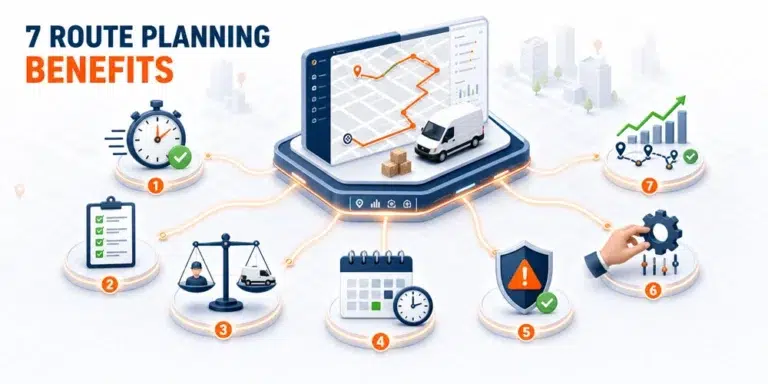
This article follows those effects across seven practical benefits. For a detailed explanation of the technology and constraints behind route creation, read our route optimization software guide.
Route Planning Software Benefits Begin Before Vehicles Leave
Many route problems are created before the first driver starts moving.
A route may look reasonable on a map but still be difficult to execute because:
- Customer time windows conflict
- Vehicle capacity is not considered
- Stops are assigned by habit
- Service duration is underestimated
- Delivery priorities are unclear
- Driver availability has changed
- Order information is incomplete
- Route workloads are unbalanced
Manual planning can work for a small and predictable operation. The challenge grows when more orders, drivers, customer commitments, and exceptions must be considered at the same time.
Route planning software gives the team a structured way to evaluate those variables before routes are released. The most useful route planning software benefits begin with identifying conflicts and unrealistic assumptions before they reach active delivery routes.
It does not guarantee that every delivery day will follow the original plan. Its purpose is to create a more informed starting point and make planning decisions easier to review.
The Operational Benefit Chain
Each route planning improvement can affect several parts of the business.
| Planning improvement | Immediate operational effect | Driver effect | Customer effect | Management value |
|---|---|---|---|---|
| Centralized order data | Less information recovery | Clearer stop details | Fewer preventable errors | More consistent process |
| Constraint based planning | More feasible routes | Fewer conflicting assignments | More realistic commitments | Better control of service rules |
| Automated route calculation | Faster first draft | Routes prepared earlier | More stable delivery plans | More planning capacity |
| Balanced workloads | Work distributed more appropriately | Fewer overloaded routes | Lower risk of late stops | Better use of resources |
| Multiple route drafts | Alternatives can be reviewed | Practical routes before release | Fewer avoidable changes | More accountable decisions |
| Connected execution data | Planned and actual progress can be compared | Current route context | Better delivery updates | Stronger operational learning |
| Repeatable planning rules | Less dependence on memory | Consistent assignment logic | More predictable service | Easier growth and training |
This chain is important because a planning decision rarely affects only the planning desk. Evaluating route planning software benefits across the complete chain gives the business a more accurate view than measuring route distance alone.
A poorly designed route may create driver delays, customer calls, failed deliveries, additional warehouse handling, and more work for dispatch. A better plan can reduce several of those downstream problems before they begin.
1. Faster Route Preparation
One of the clearest route planning software benefits is reducing the repetitive work required to create an initial route plan.
A manual planner may need to:
- Copy addresses into a map
- Group orders by area
- Check customer time windows
- Review vehicle capacity
- Compare driver availability
- Estimate travel between stops
- Move orders between route lists
- Recalculate the plan after every change
These decisions become harder as the number of possible stop combinations increases.
Google’s official vehicle routing documentation explains that routing problems become significantly more complex as locations and constraints are added. Software uses optimization techniques to search possible route combinations without requiring a planner to test each one manually.
The result should be treated as a planning draft, not an unquestionable answer.
The practical benefit is that dispatch can spend less time constructing ordinary routes from scratch and more time reviewing unusual orders, customer requirements, and operational exceptions.
2. More Consistent Planning Decisions
Experienced route planners often develop valuable knowledge about drivers, customers, service areas, and recurring delivery conditions.
The risk appears when essential planning logic exists only in one person’s memory.
Two planners may build different routes from the same orders because they apply different assumptions. A temporary employee may not know that one customer requires additional service time. A shift change may cause delivery priorities to be interpreted differently.
Route planning software helps turn recurring decisions into visible inputs and rules.
These may include:
- Which depot a route should use
- Which areas a driver serves
- Which vehicle can support an order
- Which time windows must be protected
- Which deliveries have higher priority
- How route duration should be limited
- Which stops must remain together
- Where manual review is required
Consistency does not mean removing human judgment.
It means using the same starting logic for routine work while allowing planners to review and adjust situations that require context.
This makes the process easier to explain, train, and improve.
3. Better Use of Drivers and Vehicles
A route can be short and still use delivery resources poorly.
One driver may receive too many stops while another finishes early. A high capacity vehicle may be assigned to a light route while a smaller vehicle receives work it cannot support. Several routes may cover nearby areas when the workload could have been grouped more effectively.
Route planning software can evaluate work across the available fleet rather than building each route in isolation.
These route planning software benefits become especially valuable when drivers, vehicles, delivery windows, and service requirements differ across the same operating day.
Useful planning inputs may include:
- Driver availability
- Vehicle capacity
- Starting location
- Route duration
- Delivery area
- Required services
- Customer time windows
- Stop priority
The objective is not to fill every vehicle to its absolute limit.
A route without any recovery time may become unstable after the first delay. Better resource use means creating workloads that are productive but still realistic.
Within It’s Here, verified delivery capabilities include multiple draft routes along with manual and automated route optimization. These tools allow teams to prepare route alternatives and apply dispatcher judgment before work moves into execution.
4. More Feasible Customer Commitments
Customer experience is often discussed as a communication problem, but many customer issues begin as planning problems.
A delivery window may be accepted without enough route capacity. A customer may receive an expectation that does not reflect the distance between stops. A high priority delivery may be placed late in a route without anyone noticing the risk.
One of the most useful route planning software benefits is connecting customer commitments with route feasibility.
This requires the planner to consider:
- Accepted delivery dates
- Customer time windows
- Expected service duration
- Route workload
- Travel time
- Stop priority
- Operational capacity
A narrow time window does not automatically create a better customer experience. It creates value only when the operation can meet it consistently.
Route planning software helps identify where commitments conflict before routes are released. Dispatch can then review the plan, adjust the route, or resolve the underlying scheduling issue while there is still time to act.
The commercial delivery management software from It’s Here connects route optimization with real time visibility, ETA information, driver workflows, customer updates, and completion records. This broader connection helps keep the route plan tied to the delivery experience it is intended to support.
5. Earlier Detection of Difficult Routes
A route does not need to fail completely before it becomes a problem.
Warning signs may already be visible during planning:
- Too many narrow time windows
- Excessive workload for one driver
- Long travel between specific stops
- Little recovery time
- Orders with incomplete instructions
- Capacity close to the vehicle limit
- Several complex services on the same route
- A high priority stop placed late in the sequence
Manual planning may hide these conditions across separate spreadsheets and maps.
Route planning software brings the relevant route information into a shared view, making it easier to inspect the complete workload before release.
This gives dispatch a chance to ask:
- Which stop is most likely to create delay?
- What happens to later commitments if it does?
- Can the route be divided differently?
- Should a special order move to another driver?
- Is the route depending on an unrealistic service time?
- Does the driver have the correct vehicle and instructions?
Earlier detection is valuable because changing a draft is easier than recovering an active route after several customers have already been affected.
6. Greater Control Through Manual and Automated Planning
Automation can create an efficient first draft, but delivery operations still need control.
Software may have accurate addresses, travel data, capacities, and time windows while lacking a piece of local knowledge held by dispatch.
For example:
- A location has difficult access during a certain hour
- A customer usually needs more unloading time
- Construction has changed a familiar approach
- A particular driver understands a complex site
- Two orders should remain together for service reasons
This is why effective route planning combines automated calculation with manual review.
Automated planning is most useful for repetitive decisions based on reliable data. Manual control remains important when information is incomplete, service requirements are unusual, or several business priorities conflict.
It’s Here documents both automated and manual route optimization. Dispatchers can use automation to prepare routes and then make adjustments when operational knowledge supports a different choice.
Among the most practical route planning software benefits is this ability to accelerate ordinary planning without removing human responsibility for the final route.
7. A Stronger Feedback Loop for Future Planning
Route planning should improve as the operation learns.
The original plan contains assumptions about:
- Travel time
- Service duration
- Driver workload
- Customer availability
- Route capacity
- Delivery difficulty
Execution reveals whether those assumptions were accurate.
If the actual route differs significantly from the plan, the team should investigate why.
Possible causes include:
- Incomplete order information
- Unrealistic stop duration
- A recurring access problem
- Late route release
- A driver or vehicle mismatch
- Frequent customer changes
- Planning rules that no longer fit the operation
A connected delivery workflow makes it easier to compare planned work with delivery statuses, ETA information, exceptions, and completion records.
It’s Here documents real time shipment and driver visibility, live ETA, order history, and photo and signature proof of delivery. These capabilities provide context for reviewing what happened after a route was released.
The benefit is not simply having more historical information. It is using actual delivery outcomes to refine future planning rules.
When Route Planning Software Creates the Most Value
Not every delivery business needs the same level of route planning support.
The value usually increases when:
- Order volume is growing
- Routes change from day to day
- Customers have delivery windows
- Several drivers or vehicles are available
- Capacity differs across vehicles
- Orders require different services
- Dispatch regularly rebuilds routes
- Route knowledge depends on one employee
- Drivers receive frequent updates
- Management cannot explain recurring delays
A predictable operation with a few fixed routes may continue to use a simpler planning process.
Software becomes more useful when the number of decisions and constraints grows faster than the team’s ability to manage them consistently.
The decision should therefore be based on planning complexity, not only fleet size.
What Route Planning Software Cannot Fix Alone
The benefits depend on the quality of the operating process.
Software cannot compensate for:
Inaccurate order data
An incorrect address or missing service requirement can create a poor route regardless of the planning method.
Unclear delivery commitments
If customer dates and time windows are not confirmed, the plan begins with uncertainty.
Missing capacity information
The system cannot protect vehicle or driver constraints that were never entered.
Unrealistic service duration
A route may look feasible when every stop is assumed to take less time than it actually requires.
Weak status discipline
If actual delivery progress is not recorded, future planning cannot learn from execution.
Undefined planning objectives
The team must decide whether it is prioritizing distance, route balance, customer windows, vehicle use, or another operational outcome.
Route planning software supports a defined process. It does not define every business rule on the company’s behalf.
How to Measure Route Planning Improvement
Do not evaluate the software only by asking whether routes look shorter. Measuring route planning software benefits requires comparing planning effort, route stability, driver workload, customer commitments, and actual execution results.
Measure whether the planning process and its downstream results improve.
Useful metrics include:
Route preparation time
How long does it take to move from route ready orders to an approved plan?
Manual changes per route
How many adjustments are required before and after release?
Route workload balance
Are stops, duration, and service complexity distributed appropriately?
Time window compliance
How often are customer commitments met?
Planned versus actual duration
How closely does execution match the expected route duration?
Dispatch intervention rate
How often does an active route require help from the dispatch team?
Incomplete delivery recurrence
Are the same locations, order types, or service conditions causing repeated failures?
These measures reveal whether the software is helping the operation create plans that are faster to prepare, easier to execute, and more reliable.
Where Route Planning Creates the Most Value
The most important route planning software benefits extend beyond drawing a shorter path between stops.
The software can accelerate route preparation, make planning decisions more consistent, improve the use of drivers and vehicles, protect customer commitments, expose difficult routes earlier, combine automation with dispatcher control, and create a stronger feedback loop for future planning.
Those benefits depend on accurate inputs and clearly defined operating rules.
A delivery business should not expect software to remove every exception. It should expect a better starting plan, clearer decisions, and a more repeatable process for turning route ready orders into work that drivers can realistically complete.
FAQ
What Are the Main Route Planning Software Benefits?
The main route planning software benefits include faster route preparation, more consistent planning, better driver and vehicle use, stronger time window control, earlier risk detection, and improved review of planned versus actual performance.
Can Route Planning Software Replace an Experienced Planner?
It can automate repetitive calculations and organize planning inputs, but experienced planners remain valuable when orders involve incomplete information, unusual service requirements, local knowledge, or competing priorities.
Is Route Planning Software Useful for Small Delivery Businesses?
Yes, when planning complexity justifies it. A small fleet with changing orders and customer time windows may benefit more than a larger fleet operating fixed and predictable routes.
Does Route Planning Software Automatically Manage Active Deliveries?
Not always. Route planning prepares the route. Active delivery monitoring, status management, driver communication, and proof of delivery may require connected route or delivery management capabilities.
How Should a Company Measure Route Planning Results?
Measure route preparation time, manual changes, workload balance, time window compliance, planned versus actual duration, dispatch intervention, and recurring incomplete deliveries.