A warehouse can look busy while still operating with very little control.
Employees move quickly, orders leave the building, and inventory appears in spreadsheets. Yet receiving discrepancies remain unresolved, pickers search for stock, supervisors answer routine status questions, and completed work cannot always be traced back to a reliable record.
The most important warehouse management system benefits appear when the system reduces these control gaps. A WMS does not create value simply by replacing paper with screens. It creates value when physical warehouse activity produces accurate system records, clearer work instructions, earlier exception signals, and more consistent execution.
The practical question is not, “What benefits does a WMS offer?
It is: Which warehouse process changes, and how will the operation know that the change is valuable?
Warehouse Management System Benefits Begin With Process Control
A warehouse management system helps connect inventory records with the work performed on the warehouse floor.
That connection matters because every physical movement creates a decision:
- Was the expected product received?
- Where should it be stored?
- Is the recorded location correct?
- Which inventory should be allocated to an order?
- What should the picker collect?
- Was the correct item packed?
- Did the shipment leave with the required records?
When these decisions are handled through separate spreadsheets, messages, printed lists, and employee memory, the warehouse creates multiple versions of the truth.
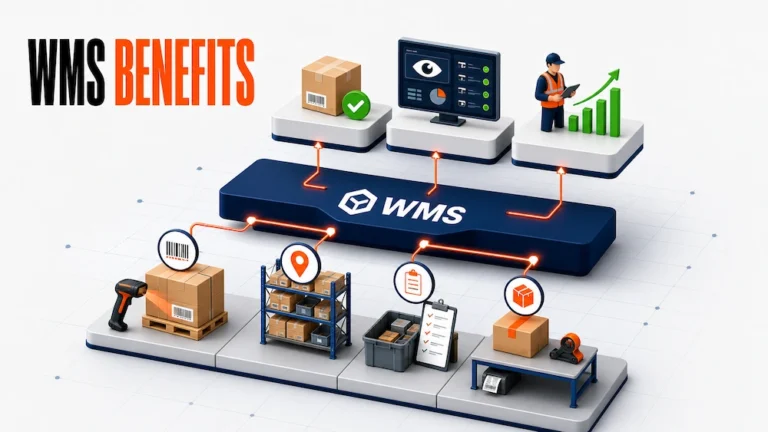
One of the most practical warehouse management system benefits is giving each activity a structured place in the operating process. The value comes from keeping the physical state and system state aligned closely enough that employees can make the next decision from reliable information.
For a complete explanation of this operating model, see our warehouse management system guide.
An Operational Value Map for WMS Benefits
The following framework connects common warehouse problems with the process change a WMS can support.
| Operational problem | WMS supported change | Leading indicator | Operational outcome |
|---|---|---|---|
| Received goods remain unidentified or unverified | Structured receipt validation and scanning | Time from arrival to validated receipt | Inventory becomes available with clearer status |
| Employees search for products | Recorded warehouse and stock locations | Search time and location exceptions | Faster and more predictable retrieval |
| Inventory records differ from physical stock | Movement records update as work occurs | Inventory adjustments and unexplained discrepancies | Greater confidence in available inventory |
| Pickers work from outdated or incomplete lists | Current order data guides picking activity | Pick exceptions and repeated handling | More consistent order preparation |
| Packing errors are discovered after dispatch | Packing validation occurs before shipment closure | Packing corrections and shipment holds | Fewer preventable outbound errors |
| Supervisors cannot identify where work is delayed | Status and activity records reveal process stages | Age of work waiting at each stage | Earlier intervention and better workload control |
| Multiple warehouses maintain separate records | Locations operate inside a connected structure | Transfers requiring manual reconciliation | Better coordination across facilities |
| Completed work is difficult to investigate | Transactions preserve operational history | Time required to answer an order inquiry | Faster issue resolution and stronger accountability |
This table is not a promise that software automatically produces every result.
The system must be configured around accurate data and clear workflows. Employees must use the process consistently. Management must also measure the operation before and after implementation.
More Reliable Inventory Starts With Better Transactions
Inventory accuracy is often presented as a single percentage. That number can hide the process failures that created the discrepancy.
An item may exist in the warehouse but appear in the wrong location. A receipt may be entered with the wrong quantity. Inventory may be moved physically without recording the transfer. A damaged unit may remain available in the system. A picked product may not be deducted until much later.
A WMS improves control by creating defined transaction points around activities such as:
- Receiving
- Location assignment
- Putaway
- Internal transfers
- Allocation
- Picking
- Packing
- Shipping
- Returns and adjustments
The benefit does not come from recording more data for its own sake. It comes from recording the event when it matters.
If an employee scans a product during receiving and confirms its storage location during putaway, the warehouse gains two operational signals. It knows that the product arrived and where it should be found.
That is more useful than discovering a discrepancy during a later stock count.
A dedicated inventory management software workflow may manage broader stock availability and inventory records. A WMS adds warehouse execution context by connecting that inventory to locations, movements, orders, and frontline tasks.
Receiving Becomes the First Control Point
Receiving affects every process that follows it.
If the product, quantity, condition, or order reference is incorrect at arrival, the error may continue into storage, allocation, picking, and customer fulfillment.
The ASCM guide to warehouse management describes warehouse operations as beginning with goods receipt and accuracy checks before products move to designated storage locations.
A controlled receiving process should help the team distinguish between:
- What was expected
- What physically arrived
- What was validated
- What requires investigation
- What can become available for later work
This creates one of the most valuable benefits of WMS: exceptions can be identified near their source.
Without this control, the warehouse may appear to receive goods quickly while transferring unresolved problems into inventory.
Useful receiving measures include:
- Time from arrival to validated receipt
- Quantity of unresolved receipt discrepancies
- Receipts requiring manual correction
- Products waiting without an assigned location
- Time between validation and putaway
These indicators reveal whether receiving is creating reliable inventory or simply moving goods away from the dock.
Location Control Reduces Search Work
Warehouse productivity is often discussed in terms of how quickly employees move. A better question is how much of that movement is necessary.
Search work includes:
- Looking for products in the wrong location
- Checking several racks for the same SKU
- Asking another employee where stock was moved
- Returning to a workstation for updated information
- Discovering that allocated inventory cannot be found
A warehouse management system can connect products with warehouses, zones, aisles, racks, bins, or other stock locations supported by the operation.
The value is not merely that the system stores a location field. The recorded location must stay aligned with physical movement.
Location control can improve:
- Putaway consistency
- Product retrieval
- Replenishment decisions
- Inventory investigation
- Shift handoffs
- Training for new employees
It can also reduce dependence on the employee who remembers where everything is stored.
The strongest measure is not total walking distance alone. Managers should also review search time, location exceptions, repeated touches, and the number of orders delayed because inventory could not be found where expected.
Picking and Packing Become Easier to Validate
Picking is where inventory records become customer orders.
A correct inventory balance does not guarantee a correct shipment. The employee still needs the right product, quantity, location, and order context.
A WMS can support this stage by keeping current order information connected to picking and packing activities.
Depending on the verified workflow, that may include:
- Generated picking lists
- Product and quantity details
- Stock location information
- Barcode or QR code scanning
- Item validation
- Packing station workflows
- Shipment records
The It’s Here warehouse fulfillment software documents stock location and product management, receipt and shipment orders, mobile scanning, picking and packing validation, multiple warehouse support, and real time inventory updates.
These capabilities help create control points before an incorrect shipment leaves the facility.
However, software should not be credited for every improvement automatically. If product labels are inconsistent, locations are not maintained, or employees bypass validation, errors can continue inside a digital workflow.
Measure the change through:
- Pick exceptions
- Items returned to storage
- Packing corrections
- Orders placed on hold
- Shipments reopened after packing
- Customer issues linked to incorrect items or quantities
Supervisors Gain Earlier Exception Signals
Many warehouse problems are visible only after someone asks a question.
A customer wants an update. The warehouse checks the order, contacts the floor, searches for the product, and reconstructs what happened.
A connected workflow changes the timing of that investigation.
Instead of learning about the problem after a missed commitment, supervisors can monitor work that remains:
- Unvalidated after receiving
- Without a stock location
- Waiting for picking
- Incomplete at packing
- Held before shipment
- Requiring correction
This does not mean every alert should be automated or every delay should trigger escalation.
The operational benefit is that work has a current state. Managers can decide which states require intervention and how long work should remain there before it becomes an exception.
This is one of the less visible warehouse management system benefits. The system reduces the time spent reconstructing the past and gives supervisors more opportunity to influence the current shift.
Multiwarehouse Operations Gain a Shared Structure
A second warehouse often creates more than double the coordination work.
Each location may develop separate product records, naming conventions, spreadsheets, and transfer processes. Management then spends time reconciling information before making network decisions.
A connected warehouse structure can help teams see:
- Which facility holds the inventory
- Where the product is located inside that facility
- Which orders are connected to each warehouse
- Which transfers are in progress
- Which location completed the work
- Which users can access or change records
This visibility can support better coordination, but it should not be confused with automatic optimization.
A system can provide the information needed to compare locations. The company must still define transfer rules, service areas, operational ownership, and the conditions that determine where work should be performed.
Labor Value Comes From Removing Avoidable Work
A WMS should not be evaluated only by asking whether employees complete more tasks.
It should also reduce work that should not have been necessary, including:
- Reentering order information
- Searching for inventory
- Reprinting outdated lists
- Reconciling separate files
- Correcting preventable picking errors
- Calling for routine status updates
- Investigating incomplete records
This distinction matters because a warehouse may increase throughput temporarily by asking employees to work faster. That is different from creating a process that requires fewer unnecessary steps.
Useful measures include:
- Orders or lines completed per labor hour
- Time spent searching for stock
- Manual corrections per order
- Supervisor interventions
- Repeated product handling
- Training time for routine workflows
- Work waiting between stages
These measures should be reviewed together. Faster picking is not a meaningful improvement if packing corrections rise at the same time.
Better Records Improve Customer and Back Office Work
Warehouse activity affects departments outside the facility.
An unclear receipt can create an inventory dispute. An incomplete shipment record can delay customer support. Missing operational evidence can complicate billing. A packing error can create a return and another fulfillment cycle.
A WMS can preserve a connected history of the work performed around an order or product.
That record may help teams answer:
- When was the product received?
- Which location held it?
- Was it moved?
- Which order used the inventory?
- Was picking or packing completed?
- When was the shipment created?
- Which exception interrupted the process?
These warehouse management system benefits extend beyond warehouse productivity by reducing the administrative effort required to investigate orders, reconcile activity, and communicate with customers or merchants.
How to Measure Value Without Making Unsupported ROI Claims
Warehouses should establish a baseline before implementation or major workflow changes.
Choose a small set of operational measures connected to the problems the system is expected to solve.
| Expected benefit | Baseline measure | Follow up measure |
|---|---|---|
| Better receiving control | Receipt discrepancies and validation time | Same measures after adoption |
| Improved location accuracy | Search time and location exceptions | Same measures by warehouse or zone |
| More consistent picking | Pick errors and repeated handling | Same measures by order type |
| Stronger packing control | Packing corrections and reopened shipments | Same measures after validation changes |
| Earlier exception response | Time between problem occurrence and detection | Detection and resolution time |
| Better record retrieval | Time required to investigate an order | Same inquiry completed through system history |
Avoid counting the same change twice.
For example, if reduced search time increases available labor capacity, do not also count the full value of that labor as a separate saving unless it produces an independently measurable result.
Benefits should also be described carefully. A system can support better accuracy and productivity, but the outcome depends on implementation, data quality, process design, training, and adoption.
Where Operational Value Actually Appears
The strongest warehouse management system benefits are created at the points where physical work and system information meet.
Receiving creates value when expected and actual goods are reconciled. Location control creates value when employees can find inventory where the system says it is. Picking and packing create value when errors are identified before shipment. Operational visibility creates value when supervisors can respond before delayed work becomes a failed commitment.
A WMS is therefore most useful when it does more than store warehouse records.
It should help the operation create reliable transactions, guide repeatable work, expose exceptions, and preserve enough history to understand what happened.
That is the difference between digitizing warehouse activity and improving warehouse control.
FAQ
What Are the Main Warehouse Management System Benefits?
The main warehouse management system benefits include stronger inventory and location control, more consistent receiving and fulfillment workflows, earlier exception visibility, reduced search and reconciliation work, and better operational records.
How Can a WMS Improve Inventory Accuracy?
A WMS can record inventory events during receiving, putaway, transfers, picking, packing, shipping, and adjustments. Accuracy improves when employees record those events consistently and physical movements remain aligned with system transactions.
Does a WMS Automatically Increase Warehouse Productivity?
No. The system can reduce avoidable work and provide clearer instructions, but productivity also depends on warehouse layout, product data, process design, training, staffing, equipment, and user adoption.
Which WMS Benefits Should a Small Warehouse Measure First?
Begin with the problems creating the most repeated work. Useful starting measures include search time, receiving discrepancies, location exceptions, pick errors, packing corrections, and the time required to investigate an order.
How Long Does It Take to See WMS Benefits?
The timing depends on implementation scope, data quality, process complexity, training, and adoption. Some workflow improvements may appear early, while reliable trends require enough operating data to compare with the preimplementation baseline.