A green Completed status proves that someone changed an order record. It does not always prove where the delivery was left, who received it, what condition it was in, or whether the driver followed the required handoff process.
That distinction matters when a customer cannot find an order, a client questions a completed stop, or an item arrives damaged. The team needs more than a status. It needs a record that connects the right order to a specific delivery event.
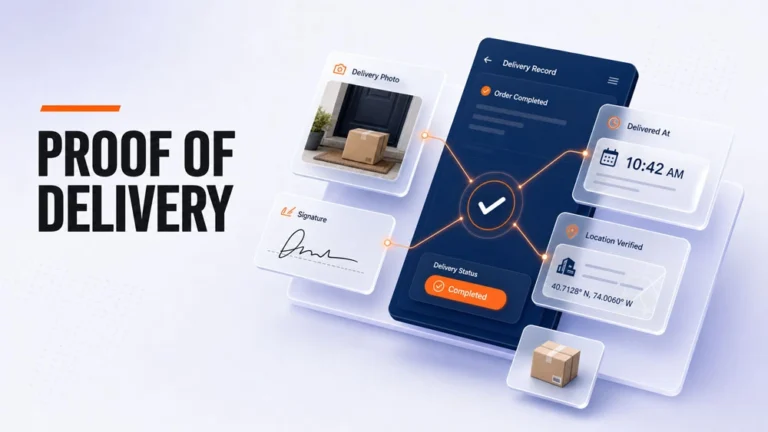
So, what is proof of delivery? Proof of delivery is the evidence collected to confirm that goods reached the intended destination or recipient under the required delivery conditions. Depending on the service, that evidence may include a signature, photograph, recipient name, timestamp, location, driver note, or a combination of these details.
The useful question is not whether a business collects POD. It is whether the evidence collected is appropriate for the delivery risk and easy to retrieve when someone needs it.
Proof of Delivery Is an Evidence Package
Proof of delivery is often described as a signature. That definition is too narrow.
A signature may be appropriate when a named person must receive an item. A photograph may be more useful for an unattended doorstep delivery. A building material supplier may need images showing both the delivery location and the visible condition of the load. A medical or age restricted delivery may require an identity controlled handoff under applicable rules.
The proof of delivery meaning therefore depends on what the sender needs to establish:
- Order identity: Which shipment or delivery was completed?
- Place: Where was it handed over or left?
- Time: When did the delivery occur?
- Recipient: Who accepted it, when a person must receive it?
- Condition: What visible condition were the goods in?
- Method: Was the required delivery procedure followed?
Strong POD combines the relevant elements into one record. Collecting more evidence is not automatically better. The objective is to capture enough information to answer a foreseeable question without adding unnecessary friction for the driver or customer.
A Delivery Status Is Not the Same as POD
Tracking and proof serve different moments in the delivery journey.
Live order tracking explains what is happening while an order is moving. It may show statuses, driver progress, or an estimated arrival time. Proof of delivery records evidence at the point of completion.
| Record | Question it answers | Typical information |
|---|---|---|
| Tracking event | Where is the order in the delivery process? | Current status, time, location, ETA |
| Delivery confirmation | Has the system marked the order complete? | Completion status and notification |
| Proof of delivery | What evidence supports the completion? | Signature, photo, recipient, time, location, notes |
| Bill of Lading | What goods were transferred under the shipment document? | Shipper, consignee, goods, quantity, freight terms |
A Bill of Lading and POD may appear in the same workflow, but they are not interchangeable. The Bill of Lading documents the shipment and its terms or contents. POD focuses on evidence of the final delivery event. Keep detailed Bill of Lading coverage with the site’s existing Bill of Lading content rather than expanding this article into freight documentation.
The Main Types of Proof of Delivery
The right POD method depends on the service promise, delivery environment, and likelihood of a later dispute.
Recipient Signature
A signature records that a person accepted the delivery. The record is stronger when the system also associates it with the recipient’s printed name, order number, date, time, and delivery location.
Carrier practices illustrate this clearly. Canada Post’s signature service records the signer’s name and signature and links the activity to the tracking number. A signature is most useful when a personal handoff is part of the service requirement.
Delivery Photograph
A photograph can show where an item was placed and its visible condition at that moment. It is useful for unattended deliveries, property safe places, furniture, appliances, building materials, and orders where location details matter.
One image may not answer every question. The driver may need to frame the address marker, entrance, item, or condition clearly enough to make the photograph meaningful. The customer’s private information and surroundings should also be handled carefully.
Location and Timestamp
Location and time data provide context for the completion event. They can help distinguish between two similar addresses, identify when the handoff occurred, and compare the delivery record with the planned stop.
They do not prove everything by themselves. A location point may show that a device was near the destination, but not who received the goods or their condition.
Driver Notes and Exception Codes
Structured notes can capture details that a photograph or signature cannot explain:
- Delivered to reception
- Left at an approved safe place
- Recipient declined to sign
- Visible packaging damage noted
- Partial quantity accepted
- Access instructions followed
Free text is useful for unusual facts, but repeatable outcomes should use consistent options that are easier to search and review.
Paper Proof of Delivery
Paper forms can still work in low volume or contract specific operations. They may include an order reference, recipient signature, date, time, item count, and delivery notes.
The weakness appears after collection. Paper can be incomplete, difficult to search, separated from the order, or unavailable until the driver returns.
Choosing Evidence by Delivery Risk
The types of proof of delivery should match the consequence of getting the handoff wrong.
| Delivery situation | Evidence to consider | What the record should help confirm |
|---|---|---|
| Unattended parcel | Photo, timestamp, location, safe place note | The order was left at the correct place |
| Attended home delivery | Recipient name, signature, timestamp | A person accepted the order |
| Furniture or appliance | Signature, item photos, condition notes | The correct items arrived and visible condition was recorded |
| Building material delivery | Location photos, quantity note, site contact | The load reached the intended site and handoff point |
| Business reception | Recipient name, signature or photo, company location | An authorized point at the business accepted it |
| Regulated or identity controlled item | Required identity and signature procedure | The required recipient control was followed |
| Failed attempt | Attempt photo where appropriate, reason code, timestamp, notes | Why completion did not occur and what should happen next |
This matrix should become a policy, not a suggestion drivers must interpret at every stop. Define which evidence is mandatory, what makes a record unacceptable, what happens when evidence cannot be collected, who reviews it, and how long it must remain accessible.
Requirements involving identity, regulated goods, contracts, or record retention should be reviewed against the applicable law and customer agreement. A digital record is not automatically sufficient merely because the software can collect it.
How an Electronic Proof of Delivery Workflow Works
Electronic proof of delivery, often shortened to ePOD, keeps the completion evidence connected to the digital order record.
A controlled workflow usually follows this sequence:
- The order reaches the driver with its delivery instructions and required POD fields.
- The driver arrives and completes the required handoff.
- The driver records the result through the mobile workflow.
- Required evidence is checked before completion can be submitted.
- The completion event and evidence are associated with the order.
- Office staff can review the record without waiting for paperwork to return.
- The evidence remains available for customer questions, client review, and operational analysis.
The control in step four matters. If a delivery requires a signature and condition photo, those requirements should be visible before the driver closes the stop.
The delivery management software from It’s Here documents driver app access, photo and signature proof of delivery, order histories, Bills of Lading, manifests, and shipping labels. These capabilities can keep completion records closer to the delivery workflow instead of scattering evidence across paper forms, messages, and personal devices.
Where Digital POD Creates Operational Value
The most practical proof of delivery benefits appear after the driver completes the stop.
- Faster answers: Customer service can review the order record without first locating the driver.
- Less recovery work: Digital capture can reduce the need to collect, scan, name, and attach paper forms.
- Clearer client accountability: Courier companies and 3PLs can show how an order was completed through one evidence package.
- Better exception analysis: Consistent reasons, notes, photos, and timestamps expose recurring delivery problems.
- Stronger back office handoffs: Customer service, claims, invoicing, and account teams can refer to the same completion record.
Weak POD Records and How to Repair Them
A record can exist and still be poor evidence.
| Weak record | Why it fails | Better control |
|---|---|---|
| Photo shows only the package | Destination is unclear | Include a recognizable handoff or location context |
| Signature has no printed name | Recipient identity is difficult to interpret | Capture signer name with the signature |
| Driver note says “done” | It adds no factual detail | Use a specific outcome or exception reason |
| Completion has no time or order link | The event cannot be matched reliably | Associate evidence automatically with the order and timestamp |
| Evidence is stored on a personal phone | Office access and retention are unreliable | Return evidence to the shared delivery record |
| Every service uses the same POD rule | Evidence may be excessive or insufficient | Set requirements by delivery type and risk |
Managers should sample completed and failed deliveries regularly. Ask whether an employee unfamiliar with the stop could understand what happened from the record alone.
Build a POD Standard Before Configuring Software
Start with recent delivery questions and disputes. Identify which facts were missing and which evidence would have resolved the issue sooner.
Then create a simple standard for each major service:
- Required evidence
- Acceptable alternatives
- Driver instructions
- Privacy boundaries
- Exception procedure
- Review owner
- Access and retention requirements
Test the standard with drivers before applying it across the operation. The final workflow should make correct evidence easier to collect than incomplete evidence.
From Completed Status to Defensible Record
Understanding what is proof of delivery requires separating a completion signal from the evidence behind it.
A reliable POD record identifies the order, captures the relevant time and place, and adds the recipient, condition, or method evidence required for that service. Electronic workflows make the record easier to connect, retrieve, and review, but technology does not decide what evidence the business actually needs.
Define the delivery risk first. Set a clear evidence standard for each service. Then configure the driver and office workflow so that every completed stop produces a record the team can understand later, even when the original driver or dispatcher is unavailable.
FAQ
Is Proof of Delivery the Same as a Tracking Update?
No. A tracking update shows progress or status during the delivery process. Proof of delivery records evidence supporting the final handoff or completion event.
Does Proof of Delivery Always Require a Signature?
No. The appropriate evidence may be a photograph, recipient name, timestamp, location, signature, driver note, or a combination. Signature requirements depend on the service, customer agreement, and any applicable rules.
What Information Should Electronic Proof of Delivery Include?
At minimum, an ePOD record should identify the order and completion time. Depending on the delivery, it may also need the location, recipient name, signature, photographs, condition notes, and exception details.
What Is the Difference Between Proof of Delivery and a Bill of Lading?
A Bill of Lading documents the shipment, parties, goods, and freight details. Proof of delivery records evidence that the delivery event occurred under the required conditions.
How Long Should a Business Keep POD Records?
There is no single retention period for every operation. The appropriate period depends on customer contracts, claim windows, business needs, applicable regulations, and the type of goods delivered.