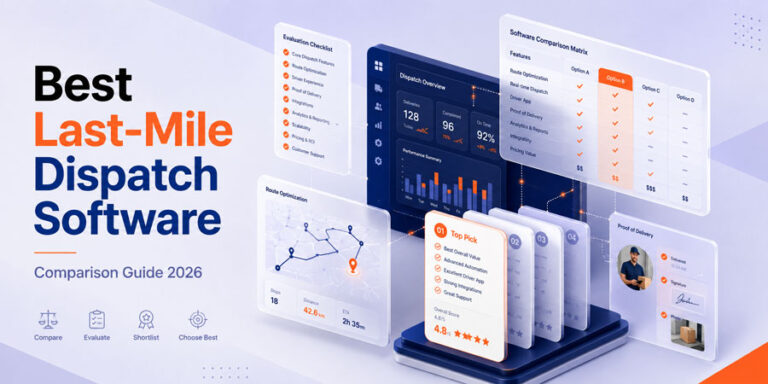
A list of popular software names is not enough to identify the best dispatch management software for last mile delivery.
A platform designed for a growing local fleet may not support the operating model of an enterprise retailer using owned drivers, third party carriers, and installation crews. A system built around rapid route optimization may not provide the appointment scheduling controls required for furniture, appliance, or other attended deliveries.
The right choice depends on how orders enter the operation, how delivery dates are confirmed, who performs the work, what dispatch must control during execution, and which records are required after completion.
This 2026 comparison does not declare one universal winner. It identifies six platforms with different published strengths and explains which operating environments should consider each one.
For the fundamentals behind this software category, read our dispatch management system guide.
How We Evaluated the Software
This comparison is based on public product information reviewed in July 2026.
The platforms were assessed across six areas:
- Order intake and scheduling: How work enters the system and becomes ready for delivery.
- Dispatch and route control: How routes, drivers, assignments, and changes are managed.
- Driver execution: What information and tools drivers receive.
- Operational visibility: How dispatch monitors current delivery progress.
- Customer communication and proof: How recipients are updated and completion is documented.
- Operating model fit: Whether the platform appears designed for growing fleets, appointment delivery, 3PL operations, or enterprise delivery networks.
Pricing was not used as a ranking factor because public plans, volume limits, modules, and implementation costs can change. Buyers should request a current quote and compare total cost using a consistent workload.
This is a decision guide, not a hands on laboratory benchmark. Product claims should be verified in a live demo using your orders, constraints, users, and exception scenarios.
Best Dispatch Management Software: Quick Comparison
| Platform | Best fit based on published positioning | Notable verified capabilities | What to verify in a demo |
|---|---|---|---|
| It’s Here | 3PLs and scheduled delivery operations that need connected scheduling and delivery workflows | Order Pool, customer date offers, route creation, optimization, live visibility, driver app, POD, 3PL billing | Integration scope, permissions, reporting, and configuration for your client structure |
| Onfleet | Delivery operations using owned drivers, delivery partners, or both | AI route optimization, auto dispatch, live tracking, driver app, customer notifications, POD, analytics | Required plan, automation controls, partner network fit, and total volume cost |
| Bringg | Enterprise retailers and logistics providers managing owned, 3PL, or hybrid fleets | Fleet orchestration, flexible service levels, scheduled and express delivery, real time insights | Implementation scope, integration requirements, governance, and fit for smaller teams |
| DispatchTrack | Scheduled, appointment sensitive, big and bulky, furniture, appliance, and field service delivery | Routing, self scheduling, delivery windows, visibility, exception alerts, customer communication, POD | Modules required, industry configuration, scheduling rules, and integration effort |
| Routific | Growing delivery businesses prioritizing route planning and a straightforward driver workflow | Route optimization, dispatcher view, driver app, customer tracker, GPS tracking, notifications, POD | Complex scheduling, multi client operations, reporting depth, and integration needs |
| Spoke Dispatch | Teams needing live route control, in flight changes, driver tracking, and detailed POD | Route planning, live tracking, dynamic ETAs, photos, signatures, barcode scanning, stop reassignment | Scale requirements, scheduling complexity, history retention, and client account workflows |
1. It’s Here
Best fit: Scheduled delivery, 3PL, and connected operational workflows
It’s Here is worth considering when dispatch is connected to appointment scheduling, route preparation, driver execution, proof of delivery, and other 3PL workflows.
Its verified Delivery Scheduler process lets teams:
- Add orders manually or through Excel
- Organize work in an Order Pool
- Search, filter, and select multiple orders
- Review delivery locations through Map View
- Send customers delivery date options
- Track Not Offered, Offered, and Accepted statuses
- Create routes from confirmed orders
The wider Delivery Management platform includes manual and automated route optimization, real time shipment and driver visibility, ETA information, a driver app, order history, and digital photo and signature proof of delivery.
It’s Here also documents automated 3PL billing with client based and service based rate structures. That adjacent billing capability may be relevant for logistics providers that need the delivery record to support invoicing.
The strongest reason to shortlist the platform is not one isolated feature. It is the connection between scheduling, route preparation, execution visibility, delivery evidence, and broader logistics administration.
The dedicated delivery scheduling software workflow is particularly relevant when customers must accept delivery dates before orders become route ready.
Verify during the demo
Ask the team to demonstrate:
- An order moving from the Order Pool to an accepted date and drafted route
- Merchant or client separation
- Manual versus automated route preparation
- Driver access to instructions
- Retrieval of photos, signatures, and order history
- How delivery services move into billing
- Permissions, integrations, and reporting required by your operation
2. Onfleet
Best fit: Mature last mile operations combining internal and external delivery capacity
Onfleet positions its platform for companies using their own drivers, delivery partners, or a combination of both.
Its current public product pages describe:
- Real time driver and delivery visibility
- AI powered route optimization
- Auto dispatch for on demand orders
- Customer tracking pages and automated notifications
- Driver communication
- Photos, signatures, barcodes, timestamps, and notes for proof of delivery
- Unified analytics across fleets and delivery partners
- APIs and integrations
Onfleet may be a strong candidate when an operation needs a mature execution layer covering routing, dispatch, tracking, customer communication, and POD within the same platform.
Its mixed fleet positioning also makes it relevant for businesses that do not want outsourced deliveries to become a separate operational blind spot.
Verify during the demo
Test:
- How auto dispatch decisions are controlled or overridden
- How active routes respond to new orders
- What customers see when a delay occurs
- How internal and partner fleet performance is compared
- Which integrations are native and which require development
- Which features are available on the proposed plan
3. Bringg
Best fit: Enterprise retail and complex hybrid delivery networks
Bringg is designed around enterprise retailers and logistics providers that coordinate owned fleets, 3PLs, and hybrid delivery networks.
Its public positioning emphasizes:
- Standardized operations across different fleet types
- Scheduled, same day, and express service levels
- Precise delivery windows
- Support for big and bulky, white glove, grocery, and other complex product types
- Real time operational data
- Enterprise integrations
- Delivery orchestration across providers
Bringg should enter the shortlist when the main problem is broader than assigning routes to an internal fleet.
An enterprise may need to determine whether work should move through an owned driver, regional 3PL, or another delivery provider while maintaining consistent service levels and visibility.
That orchestration requirement is different from the needs of a small company using one dispatch team and one driver group.
Verify during the demo
Ask:
- How provider allocation rules are configured
- How service levels differ by order type
- How owned and third party execution appears in one view
- Which integrations are required before launch
- How exceptions are managed across providers
- What implementation resources the customer must supply
4. DispatchTrack
Best fit: Appointment driven, big and bulky, and scheduled delivery
DispatchTrack is especially relevant to operations where time windows, appointment reliability, customer communication, and complex delivery execution carry significant weight.
Its official pages describe:
- AI powered routing and scheduling
- Customer self scheduling based on operating rules and available capacity
- Real time fleet, driver, order, and ETA visibility
- Configurable exception alerts
- Customer text and email updates
- Live order tracking
- Photos, signatures, notes, and timestamped proof of delivery
- Workflows for furniture, appliance, building supply, and other complex deliveries
DispatchTrack’s published industry positioning makes it a logical candidate for furniture, appliance, building material, field service, and other operations where a failed appointment creates substantial recovery work.
Its self scheduling workflow is also relevant when customer date selection must remain aligned with actual capacity.
Verify during the demo
Test:
- How available delivery windows are generated
- How capacity and regional rules affect customer options
- What happens when a customer reschedules
- Which conditions generate exception alerts
- How big and bulky requirements reach the driver
- Which modules are included in the proposed implementation
5. Routific
Best fit: Growing delivery businesses focused on route quality and ease of use
Routific positions itself as delivery management and route optimization software for growing businesses.
Its published capabilities include:
- Route optimization
- Dispatcher views
- A mobile driver app
- Real time GPS tracking
- Customer email notifications
- A customizable delivery tracker
- Proof of delivery
- Multiple depots and workspaces
Routific may be a suitable shortlist option when the primary objective is to replace manual route planning with a clearer dispatcher and driver workflow without beginning with a large enterprise orchestration project.
The platform appears particularly relevant for recurring local delivery operations that need optimized routes, driver progress, customer visibility, and completion records.
Verify during the demo
Ask the vendor to show:
- A realistic route with time windows and capacity constraints
- Manual adjustments after optimization
- The driver’s end to end experience
- Customer notifications and tracking
- Failed delivery documentation
- Support for multi client billing, appointment scheduling, or complex 3PL rules when required
6. Spoke Dispatch
Best fit: Live execution control, driver workflows, and detailed proof of delivery
Spoke Dispatch combines route planning with live operational control.
Its official product pages describe:
- Route planning and optimization
- Real time driver, route, and stop visibility
- Dynamic ETAs
- Delivery photos and recipient signatures
- Barcode scanning
- Shared stop notes
- Safe place and neighbor delivery records
- In flight stop changes
- Reassignment of stops to available drivers
- Read only visibility for clients and stakeholders
Spoke is worth evaluating when dispatchers need to make changes during the delivery day and preserve detailed evidence about where, when, and how an order was completed.
Its live operation features may also help teams that currently manage in flight changes through calls and messaging groups.
Verify during the demo
Test:
- How a dispatcher identifies an at risk delivery
- How a stop is changed or reassigned after release
- What information transfers to the new driver
- Which POD fields can be required
- What clients can see
- Data retention, reporting, and integration requirements
Which Platform Is Best for Your Operating Model?
The shortlist becomes easier when the operating model is clear.
Choose a scheduling led platform when:
- Customers must select or accept delivery dates
- Orders should not become route ready before confirmation
- Appointment changes create significant administrative work
- Routes depend on scheduled and accepted demand
It’s Here and DispatchTrack deserve closer evaluation for this type of workflow, though their scope and target customers differ.
Choose a mixed fleet orchestration platform when:
- Work moves across owned drivers and outside providers
- The business needs consistent visibility across fleets
- Orders may be allocated according to service level, cost, or availability
- Enterprise integrations and governance are major requirements
Onfleet and Bringg should be considered for these environments.
Choose a route led platform when:
- Manual route planning is the primary bottleneck
- The operation needs a clear dispatcher view and driver app
- Customer tracking and POD are required
- Enterprise orchestration is not the immediate priority
Routific may fit this type of growing operation.
Choose an execution control platform when:
- Dispatchers frequently change active work
- Drivers need detailed stop information
- Photos, signatures, barcodes, and notes are central
- Clients or stakeholders need operational visibility
Spoke Dispatch may be a relevant candidate.
Do Not Select Software From the Feature Table Alone
Many vendors offer route optimization, tracking, customer notifications, a driver app, and proof of delivery.
The difference appears in how those capabilities work together under real operating conditions.
Use the dispatch scheduling software features checklist to create a weighted scorecard, then require each shortlisted provider to complete the same scenario.
A useful test file should include:
- An incomplete order
- Two customer time windows
- One special vehicle or service requirement
- Multiple client or merchant records
- A customer reschedule
- A driver absence
- An order added after route creation
- A failed delivery requiring another action
- A delivery requiring photo or signature proof
The demo should show how the platform handles the exception—not only the perfect order.
Questions to Ask Every Vendor
Workflow
- What makes an order eligible for scheduling or dispatch?
- Can the system preserve customer, client, and service requirements through completion?
- Which decisions are automated?
- Can dispatchers review and override those decisions?
Implementation
- Which integrations are available now?
- Which require custom work?
- Who cleans and maps the source data?
- What training is provided to dispatchers and drivers?
Commercial terms
- Is pricing based on users, drivers, orders, routes, or modules?
- Which capabilities shown in the demo are included in the quote?
- Are messaging, onboarding, integrations, and support charged separately?
- How will cost change as delivery volume grows?
Security and data
- Which user roles and permissions are available?
- Is multifactor authentication supported?
- What audit records are retained?
- How can the customer export its operational data?
- How are security incidents communicated?
The CISA Secure by Demand guide recommends assessing product security during procurement rather than treating it as an issue to investigate only after deployment.
Compare Total Value, Not Only Subscription Price
A lower subscription price does not necessarily create a lower cost operation.
Evaluate:
- Implementation and integration
- Dispatcher and driver training
- Messaging fees
- Data preparation
- Internal project time
- Manual work that remains after launch
- Additional modules
- Support requirements
- Cost as delivery volume increases
Then compare those costs with measurable operational changes.
Our dispatch software ROI guide provides a framework for calculating implementation cost, labor capacity, avoided operating expenses, and payback without counting the same benefit twice.
A platform should not win the selection because its ROI slide looks impressive. It should win because the assumptions can be measured inside your operation.
Final Recommendations by Use Case
| Use case | Platforms to shortlist first |
|---|---|
| Scheduled 3PL delivery with connected operational workflows | It’s Here |
| Owned fleet plus external delivery partners | Onfleet or Bringg |
| Enterprise retail and hybrid fleet orchestration | Bringg |
| Furniture, appliance, building supply, or appointment heavy delivery | DispatchTrack |
| Growing local fleet prioritizing route optimization | Routific |
| Live route changes and detailed POD workflows | Spoke Dispatch |
| Scheduling plus route preparation and adjacent 3PL billing | It’s Here |
| Advanced AI driven routing and auto dispatch | Onfleet |
| Customer self scheduling tied to capacity rules | DispatchTrack |
These recommendations are starting points, not automatic purchase decisions.
Conclusion
There is no universal best dispatch management software for last mile delivery.
It’s Here is a relevant choice for scheduled and 3PL workflows that connect customer date acceptance, route preparation, driver visibility, POD, and billing. Onfleet is strong for delivery orchestration across internal and partner fleets. Bringg is oriented toward enterprise hybrid networks. DispatchTrack is well aligned with appointment driven and complex deliveries. Routific focuses on growing route led operations, while Spoke Dispatch emphasizes live control and detailed execution records.
The final decision should come from a controlled comparison.
Define the operating model, build a weighted shortlist, run every vendor through the same exception heavy demo, verify product security and integrations, and calculate total cost against measurable operational benefits.
The best platform is not the one with the longest feature list. It is the one that can support your real workflow without forcing the team to rebuild critical processes outside the system.
FAQ
What Is the Best Dispatch Management Software for Last Mile Delivery?
There is no universal winner. The best option depends on whether the operation prioritizes scheduled delivery, route optimization, mixed fleets, enterprise orchestration, live execution, proof of delivery, or 3PL workflows.
Which Dispatch Software Is Best for Scheduled Deliveries?
It’s Here and DispatchTrack should be considered when delivery dates, appointment windows, customer availability, and route ready confirmed orders are central to the workflow.
Which Platform Is Best for a Growing Delivery Fleet?
Routific may suit growing businesses focused on route optimization and driver workflows. Onfleet and Spoke Dispatch may be considered when the operation needs broader execution control, depending on complexity and scale.
Which Software Supports Owned and Third Party Fleets?
Onfleet and Bringg both publicly position their platforms around owned and external delivery capacity. Bringg focuses more heavily on enterprise owned, 3PL, and hybrid orchestration.
How Should a Company Compare Dispatch Software?
Use the same order file and exception scenario for every vendor. Evaluate scheduling, routing, driver execution, visibility, customer communication, POD, integrations, security, implementation, and total cost.