The weekly delivery report shows 42 late orders. Operations blames unrealistic customer promises. Dispatch points to routes that left the facility late. Drivers mention missing access instructions, and customer service says several recipients changed their availability.
Every explanation may be partly correct. None tells the team where to begin.
Knowing how to improve on time delivery requires more than a higher target or a reminder to drivers. A business needs a controlled way to separate different types of late delivery, find the earliest preventable failure, assign corrective action, and verify whether that action worked.
This practical plan moves from diagnosis to a 30 day operating cycle without assuming that every delay has the same cause.
Start With a Trustworthy Baseline
Do not launch an improvement project until the team agrees on what counts as on time.
Confirm these rules first:
- The unit being measured, such as an order, stop, shipment, or order line
- The promised date or delivery window used for comparison
- The event and timestamp that prove completion
- The treatment of early arrivals, partial deliveries, failed attempts, and cancellations
- The denominator and reporting period
- The rule for customer requested and operational reschedules
If those definitions change during the project, the rate can improve even when execution does not.
The baseline should cover enough recent work to show recurring patterns. Segment it by service type rather than judging an attended appointment through the same assumptions as an unattended parcel.
This baseline is the foundation for deciding how to improve on time delivery without mistaking a definition change for better execution.
Build a Late Delivery Reason Tree
A generic status such as Late records an outcome, not a cause. Replace it with a reason tree that identifies where control first broke.
| Failure stage | Useful reason categories | Evidence to review |
|---|---|---|
| Promise creation | Unrealistic date, unavailable capacity, incorrect service window | Original request, accepted promise, scheduling rules |
| Order readiness | Inventory unavailable, picking delay, incomplete documentation | Ready time, order status, warehouse handoff |
| Route preparation | Route released late, workload imbalance, constraint missed | Draft time, release time, route plan, vehicle requirements |
| Driver handoff | Missing instructions, late start, unavailable driver | Assignment history, driver acceptance, departure time |
| Delivery execution | Traffic, access issue, service duration, vehicle problem | Status history, ETA changes, driver notes |
| Customer availability | Recipient absent, date change, incorrect contact details | Communication history, attempt evidence |
| Completion record | Missing or late status, weak evidence, incorrect timestamp | Proof, status time, order history |
Choose the earliest supported cause. If a route left the warehouse two hours late, recording traffic as the primary cause hides the more actionable failure. Use Unknown when evidence is insufficient and track it as a data quality problem.
A reason tree shows how to improve on time delivery by directing corrective action toward the earliest supported cause.
Separate Preventable and Unavoidable Delays
Not every late delivery can be prevented, but many can be detected or communicated earlier.
Use three control groups:
- Preventable: Incomplete address, unrealistic promise, missing instructions, late release, known capacity conflict, or incorrect assignment.
- Controllable after detection: Traffic, customer availability, or a vehicle issue where reassignment, resequencing, or communication may reduce the impact.
- Outside immediate control: Severe weather, road closure, emergency restriction, or another disruption the operation could not reasonably prevent.
The third group should remain in service reporting. Review whether response, communication, and recovery worked even when the cause was outside the team’s control.
ASCM’s guidance on delivery exceptions similarly emphasizes preparation, active monitoring, clear responsibility, and customer communication. The practical lesson is that exception management begins before the customer reports the delay.
This separation helps teams decide how to improve on time delivery even when some disruptions cannot be prevented.
Fix the Earliest Failure, Not the Loudest Symptom
Late deliveries often create a chain of visible symptoms:
Weak order data -> delayed route preparation -> late driver departure -> inaccurate ETA -> missed customer window
Customer complaints are visible, but better notifications will not correct the weak order data that started the chain.
For each recurring reason, ask:
- What was the first preventable break?
- Which team owned the process at that moment?
- Which information was missing or incorrect?
- Which leading signal could have exposed the risk earlier?
- What control would prevent recurrence?
ASCM’s analysis of late deliveries argues that organizations should examine the conditions that make driver and dispatcher errors more likely, not only the individual error. This distinction keeps the improvement plan focused on process design rather than blame.
Stabilize the Promise Before Optimizing the Route
Route changes cannot rescue commitments the operation never had capacity to meet. Review how dates and windows are offered against drivers, vehicles, service areas, service duration, warehouse readiness, and accepted work.
Useful controls include:
- Defined delivery days and unavailable dates
- Booking cutoffs and minimum lead times
- Capacity limits by date, area, vehicle, or service type
- Approval rules for urgent orders
- A history of original and revised promises
- Clear ownership when an appointment changes
Once commitments are feasible, route optimization software can organize stops around geography, windows, capacity, and constraints. It cannot consistently compensate for incomplete addresses, unavailable inventory, or impossible promises.
Feasible promises are essential to understanding how to improve on time delivery before route execution begins.
Create a Route Release Gate
Before a route reaches the driver, check whether it is executable.
A compact release gate can verify:
- Every order is ready and assigned to the correct date
- Addresses and customer contacts are complete
- Time windows and service requirements are visible
- Vehicle and crew requirements are satisfied
- Workload fits the available shift and capacity
- Special instructions have reached the driver workflow
- The route has a named owner after release
The gate should be short enough to use daily. Track routes released on time and routes reopened afterward. Frequent reopening suggests that dispatch receives unstable orders or releases work before dependencies are resolved.
Detect Risk While There Is Still Time to Act
Useful visibility provides an early signal that planned and actual execution are separating.
For each active route, compare:
- Planned departure with actual departure
- Planned stop progress with completed stops
- Current ETA with the promised window
- Remaining workload with remaining driver time
- Exception status with its assigned owner
The live order tracking guide explains how location, status, ETA, and exception information support operational decisions. The improvement opportunity comes from acting on those signals consistently.
Define thresholds that trigger review. A narrow appointment and a date based delivery may require different rules.
Early warning thresholds show how to improve on time delivery while enough recovery time remains.
Give Every Exception an Owner and Response Clock
An alert without ownership only makes a delayed order more visible.
Create a simple response workflow:
- Detect: Record the event and the time it became visible.
- Assess: Determine which commitments are affected.
- Assign: Give one person responsibility for the next decision.
- Act: Reassign, resequence, correct information, or coordinate access when feasible.
- Communicate: Update the driver, customer, warehouse, or account team affected.
- Close: Record the result, reason, and evidence.
Measure both detection time and resolution time. A team may identify risks quickly but still lose the remaining recovery window because no one owns the decision.
Clear ownership is central to how to improve on time delivery because alerts create value only when someone acts.
Preserve the Completion Record
Improvement depends on knowing what actually happened at the stop.
The completion record may include status, timestamp, location context, driver notes, photos, signatures, and failed attempt reasons. The required evidence should match the service rather than applying one proof rule to every delivery.
Our guide to proof of delivery explains how completion evidence supports investigations and customer communication. For OTD improvement, it also supplies the event data needed to distinguish late completion from late status entry.
A delivery management software workflow can connect route progress, driver visibility, ETA, customer updates, delivery status, and order history. The official It’s Here product page documents these capabilities. Technology provides the shared operational record, while the team still defines thresholds, owners, and corrective actions.
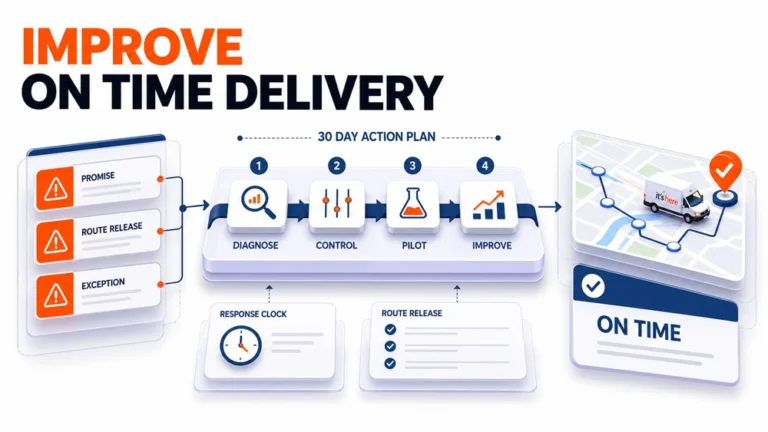
Use a 30 Day On Time Delivery Improvement Plan
Do not attempt to fix every cause at once. Run a focused cycle around the largest preventable failure category.
| Period | Main objective | Deliverable |
|---|---|---|
| Days 1 to 5 | Validate the baseline and measurement rules | Agreed definition, data quality list, segmented baseline |
| Days 6 to 10 | Classify late deliveries | Reason tree, preventability groups, top recurring cause |
| Days 11 to 15 | Design one corrective control | Owner, workflow change, leading indicator, expected behavior |
| Days 16 to 25 | Pilot the control on a defined segment | Daily observations, exceptions, adoption notes |
| Days 26 to 30 | Evaluate and decide | Before and after result, side effects, keep, revise, or stop decision |
Use a comparable group for the pilot. Changing region, order type, promise definition, and operating process simultaneously makes the result difficult to interpret.
A controlled pilot demonstrates how to improve on time delivery without changing multiple variables at once.
Calculate the Cost of Late Deliveries With Your Own Inputs
A simple calculator can prioritize causes without inventing an industry benchmark.
For a selected period, enter:
- Number of late deliveries
- Additional driver or dispatcher time per late delivery
- Internal labor cost for that time
- Redelivery and return handling cost
- Customer service handling cost
- Documented credits, claims, or service recovery cost
Then calculate:
Estimated late delivery cost = Late delivery count x Average measurable recovery cost per late delivery
Keep the estimate conservative, use supported records, and do not count the same event twice. This does not guarantee a return from software or process change. It helps compare recurring failures.
Review a Balanced Set of Results
OTD is the outcome, but leading measures show whether the new process is taking hold.
Review:
- On time delivery rate for the pilot segment
- Preventable late delivery rate
- Route release punctuality
- Promise change rate
- Exception detection and resolution time
- First attempt success rate
- Completion data coverage
- Customer notification timeliness
APQC’s 2026 overview of order management performance measures recommends a balanced set of reliability, speed, cost, and customer measures to reveal bottlenecks. One improved percentage should not conceal worse performance elsewhere.
Turn Improvement Into a Repeatable Operating Cycle
The fastest way to improve on time delivery performance is not to pressure every team equally. It is to identify the largest preventable cause, correct the earliest process failure, and verify the result on a controlled segment.
Begin with stable measurement rules. Build a reason tree, protect feasible promises, create a route release gate, detect risk early, assign every exception, and preserve trustworthy completion records. Then use a short pilot to determine whether the control should be adopted, revised, or stopped.
The goal is not to eliminate every disruption. It is to prevent avoidable failures, respond earlier to controllable problems, and learn consistently from commitments that were missed.
FAQ
How to improve on time delivery when several causes exist?
When several causes exist, deciding how to improve on time delivery starts with confirming the measurement definition and classifying late deliveries by their earliest supported cause. Then prioritize one preventable cause within a defined segment.
Which late delivery causes should be addressed first?
Prioritize causes that are frequent, preventable, measurable, and controlled by a clearly identified team. Start with one segment and one corrective control rather than changing the entire operation at once.
Can route optimization fix poor on time delivery performance?
It can improve route planning when orders, promises, constraints, and capacity data are accurate. It cannot consistently correct late warehouse readiness, incomplete addresses, impossible appointments, or unclear exception ownership.
How long should an OTD improvement pilot run?
The pilot should run long enough to include a representative volume and normal operating variation. A 30 day cycle is a practical starting structure, but seasonal or low volume operations may require a longer comparison period.
How should unavoidable delays be treated?
Keep them visible in service reporting, but separate them from preventable causes during diagnosis. Review whether detection, communication, ownership, and recovery worked even when the original disruption could not be prevented.