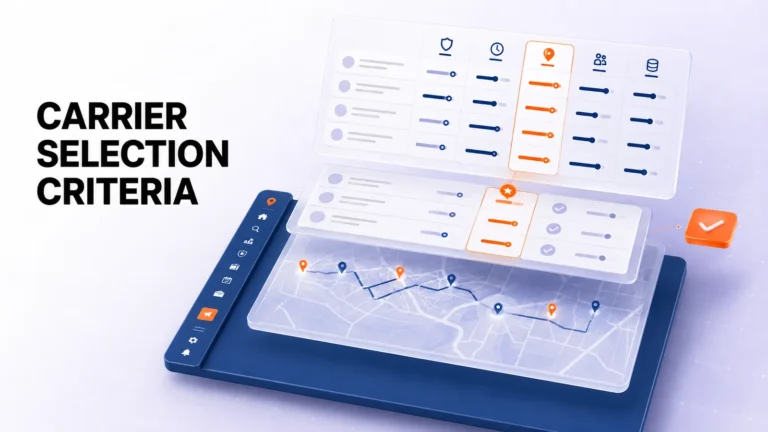
What is carrier management in logistics? It is the operating discipline used to select transportation providers, establish working rules, assign shipments, monitor execution, evaluate performance, and correct recurring problems. The objective is not simply to find a carrier for today’s load. It is to create a repeatable way to decide which carrier should handle which work, what evidence must follow the shipment, and what happens when service falls outside the agreed standard.
That discipline matters because carrier decisions connect several teams. Procurement may negotiate the agreement, operations may tender or allocate the shipment, a warehouse team may manage the handoff, customer service may handle exceptions, and finance may review invoices or claims. Without shared rules, each team can make a reasonable local decision while the overall process becomes inconsistent.
This guide explains the complete control cycle for logistics and warehouse teams without confusing carrier management with routing, tracking, or a software purchase. It also points to relevant It’s Here resources for adjacent workflows.
What Is Carrier Management in Logistics?
Carrier management is the coordinated process of qualifying, onboarding, using, measuring, and improving the external or internal transportation providers that move goods. In practical terms, it turns shipment demand into controlled carrier assignments and then turns delivery evidence into decisions about future work.
A carrier may be a parcel network, truckload or less-than-truckload provider, regional courier, specialist transporter, or internal fleet. The mix changes by business, but the management questions remain similar: Can this provider serve the required geography and shipment profile? Does it have the right capacity and authority? What service promise and evidence apply?
The answer to what is carrier management in logistics therefore includes both commercial and operational work. Rates and contracts matter, but so do pickup readiness, tender acceptance, delivery evidence, exception ownership, data quality, and corrective action. A low quoted rate has little value if the carrier cannot reliably serve the lane, handle the shipment, or provide usable status evidence.
What Carrier Management Controls and What It Does Not
Carrier management sits above several execution activities. It defines which providers can receive work and the conditions under which they should receive it. Other systems and teams may plan routes, release orders, track movement, or record proof of delivery, but the carrier management process decides how that execution evidence changes the carrier roster, allocation rules, and service expectations.
Carrier management versus routing and dispatch
Carrier selection answers who is eligible to move the shipment and under which service agreement. Routing answers how stops should be grouped and sequenced after the work is assigned, while dispatch gives an operator or driver responsibility for executing the plan. Teams that need the planning side can use the route optimization software guide rather than rebuilding route logic inside a carrier policy.
Carrier management versus shipment tracking
Tracking supplies execution evidence: current status, location events, expected arrival, exceptions, and completion records. Carrier management uses that evidence to evaluate reliability and decide what should change. The last mile delivery tracking guide explains the visibility layer in more detail.
Carrier operations versus carrier management software
The operating model should exist before a platform is evaluated. Software can organize records, rules, communications, comparisons, or reporting, but it cannot decide what the business considers acceptable service without clear requirements. This article owns the educational process; commercial searches for platforms, systems, and price-shopping tools belong to the dedicated product category.
The Carrier Management Process From Requirement to Corrective Action
The most useful way to understand what is carrier management in logistics is as a closed control loop. Every stage must produce an output that the next owner can use. If a stage ends with an email thread, an undocumented exception, or an unexplained spreadsheet change, the loop is open and the same decision will be debated again.
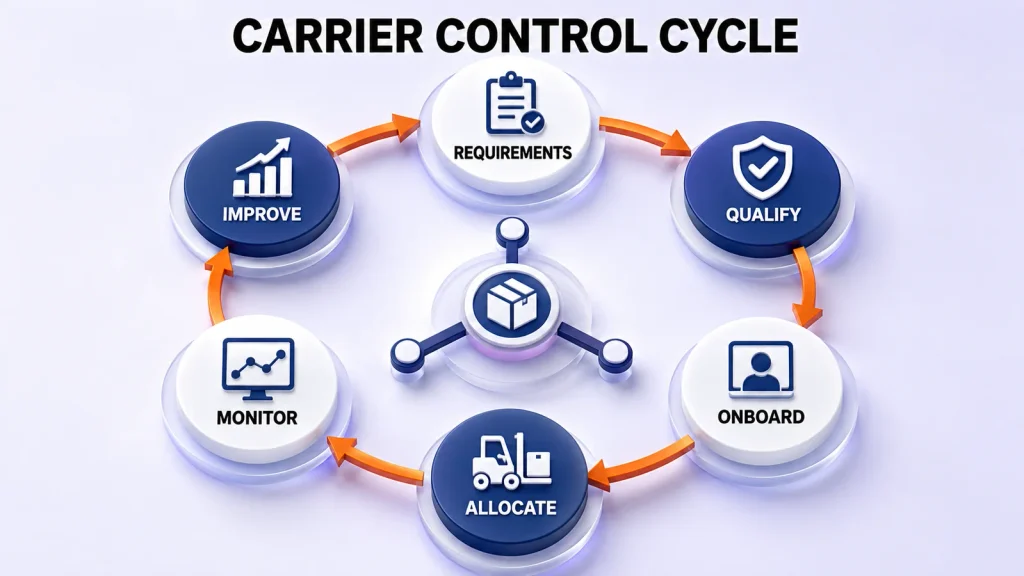
- Define the shipment requirement. Start with the work, not the carrier list. Record origin and destination coverage, shipment dimensions or handling needs, service window, expected volume, peak variation, evidence requirements, and the consequence of failure. Separate mandatory constraints from preferences so a carrier is not rejected for a negotiable issue or approved despite a critical gap.
- Qualify eligible carriers. Compare each provider with the shipment profile, operating region, capacity, safety or regulatory requirements, insurance requirements, data readiness, and escalation coverage. Verification must follow the relevant jurisdiction. For United States motor carriers, the FMCSA Company Safety Records page explains how company name, USDOT number, or Motor Carrier number can be used to access official safety information. Other countries and transport modes require their own current registries and rules.
- Agree on service and commercial rules. Document the service definition, tender response, pickup and delivery windows, accessorial conditions, evidence required at each milestone, exception notification, claims process, invoice inputs, and review cadence. A contract can contain the commercial terms while an operating playbook translates those terms into actions for dispatch, warehouse, customer service, and finance.
- Onboard the carrier into the workflow. Create a controlled carrier record, confirm contacts and escalation paths, map service codes, test data exchange, and run a representative shipment before scaling volume. The handoff should also define when a load is ready. A carrier cannot protect a pickup window if the warehouse management system or warehouse process has not produced accurate order, inventory, and staging status.
- Allocate work using explicit rules. Assignment should reflect eligibility first, then the business trade-off among service, capacity, risk, and cost. Teams may use primary and backup carriers by lane, shipment type, customer promise, or operating region. Document manual overrides with a reason; otherwise an urgent exception can quietly become the new default.
- Monitor execution and own exceptions. Define the events that show tender acceptance, pickup, movement, delivery attempt, completion, and failure. Each exception needs an owner, response clock, and next action. The goal is not to collect more status messages. It is to recognize when the shipment has departed from the agreed process while there is still time to act.
- Review performance and correct the system. Aggregate comparable shipments, validate the data, identify repeatable causes, and choose an action. The response may be a data fix, process change, coaching plan, allocation adjustment, commercial discussion, probation period, or removal from a particular service segment. Feed the decision back into qualification and allocation rules so the review changes future behavior.
The Evidence That Makes Carrier Management Auditable
A reliable process leaves a trace from requirement to decision. That trace prevents a team from rewarding a carrier for easy work, penalizing it for failures outside its control, or choosing a new provider from incomplete quotations. It also helps different departments answer the same question with the same evidence.
At minimum, maintain a carrier record, approved service scope, contacts, qualification evidence, agreement version, allocation rules, assignment reason, milestone events, exception codes, delivery evidence, invoice references, claims, and review actions. The records may live in different applications, but shipment IDs, carrier IDs, service codes, timestamp definitions, and ownership should remain consistent.
Data quality is part of carrier performance control. If promised dates change without history, exceptions use free-text descriptions, or completion means something different across carriers, the resulting scorecard can look precise while measuring inconsistent events. Before debating a KPI, confirm what event starts the clock, what event stops it, which shipments are eligible, and who can change the underlying record.
How to Measure Carrier Performance Without Misreading It
Carrier metrics should answer a decision, not fill a dashboard. A small set of measures is usually more useful than dozens of unowned indicators. Common categories include tender acceptance, pickup reliability, delivery reliability, damage or claims incidence, exception responsiveness, billing accuracy, and evidence completeness.
Use a written measurement contract for every KPI: numerator, denominator, eligible population, exclusions, time zone, tolerance, source system, data owner, and review frequency. If the team tracks delivery reliability, the on time delivery rate guide explains why the promised date, completion event, and denominator must be defined before the percentage can be trusted.
Segment results before acting. A carrier’s overall average can hide poor performance on one lane, service level, customer type, warehouse, shipment size, or peak period. Compare like with like, display sample size, and inspect the underlying exceptions. Then attach an action to the result. A metric without a decision threshold, owner, or follow-up date is only a report.
When a Multi Carrier Strategy Helps
A multi-carrier model can reduce dependency on one provider and give the operation alternatives when geography, capacity, shipment characteristics, or service promises vary. It is most useful when each additional carrier solves a defined constraint. Adding a provider simply because it offers another rate creates administrative work without necessarily improving operational coverage.
Every additional carrier also increases the number of records, service codes, contacts, data mappings, invoice rules, exception paths, and performance comparisons the team must control. Before expanding the roster, ask whether the business can keep qualification evidence current, assign work consistently, normalize events, and conduct meaningful reviews. The practical question is not how many carriers are available. It is how many distinct carrier relationships the operation can govern well.
This is where what is carrier management in logistics becomes a resilience decision. The team should know which carrier is primary, which is a backup, what condition triggers a switch, who approves an override, and how the outcome will be reviewed. Redundancy without activation rules can produce slower decisions at the moment capacity is already constrained.
A Practical Carrier Management Review Cadence
Cadence separates immediate shipment control from longer-term relationship decisions. Use intervals that match the speed of the operation and the amount of evidence available.
- During execution: monitor missed acceptances, pickup risk, stalled milestones, delivery exceptions, and missing evidence. Assign an owner and record the resolution.
- Weekly: review repeat exceptions, capacity constraints, data failures, unresolved claims, and overrides. Correct issues that could affect the next operating cycle.
- Monthly: compare segmented service performance, volume allocation, cost drivers, invoice accuracy, and corrective actions. Avoid formal scoring when the sample is too small to support a conclusion.
- Quarterly or contractually: review service fit, lane coverage, forecast changes, risk, relationship health, and agreement updates. Decide whether to expand, restrict, renegotiate, or end a service relationship.
The cadence should produce decisions and named owners. Record what changed, why, when it takes effect, and how the team will verify the result.
Where Carrier Management Software Fits
Technology becomes useful when the carrier roster, shipment volume, data sources, or exception workload exceed what a team can govern consistently through shared documents. A requirements-led evaluation should test whether a proposed system supports the team’s actual carrier records, allocation logic, evidence sources, review process, and integration boundaries. A polished demonstration is not a substitute for testing representative shipments and exceptions.
If your operation is moving from an informal carrier list to a governed multi-carrier process, map the control loop first. Then use the It’s Here carrier management software page as one commercial evaluation point and verify every required capability against current product evidence, contracts, and a controlled workflow test. This preserves the distinction between learning how carrier management works and choosing a platform.
Build the Control Loop Before You Add Complexity
The clearest answer to what is carrier management in logistics is a process that connects requirement, eligibility, assignment, execution evidence, performance review, and corrective action. When those connections are explicit, a team can explain why a carrier received the work, whether the service met the agreed standard, and what will change next.
Begin with one shipment segment and one review cycle. Define the rules, test the handoffs, verify the data, and close the first corrective action before adding more carriers or metrics. A controlled small process creates a better foundation for growth than a large carrier roster governed by exceptions and memory.
FAQ
What Is Carrier Management in Logistics for an Operations Team?
Carrier management is the process of qualifying transportation providers, defining service rules, assigning shipments, monitoring execution, measuring performance, and applying corrective action.
What Are the Main Steps in the Carrier Management Process?
The main steps are requirement definition, carrier qualification, service agreement, onboarding, allocation, execution monitoring, performance review, and improvement.
How Is Carrier Management Different From Route Planning?
Carrier management decides which provider is eligible and how its service is governed. Route planning organizes stops and travel after work is assigned.
Which Metrics Should Be Used to Measure Carrier Performance?
Useful measures include tender acceptance, pickup and delivery reliability, claims, exception response, billing accuracy, and evidence completeness. Segment results before comparing carriers.
When Does a Multi-Carrier Strategy Make Sense?
It helps when different providers solve specific coverage, capacity, shipment, or service constraints. Each carrier should have a documented role, allocation rule, and review process.